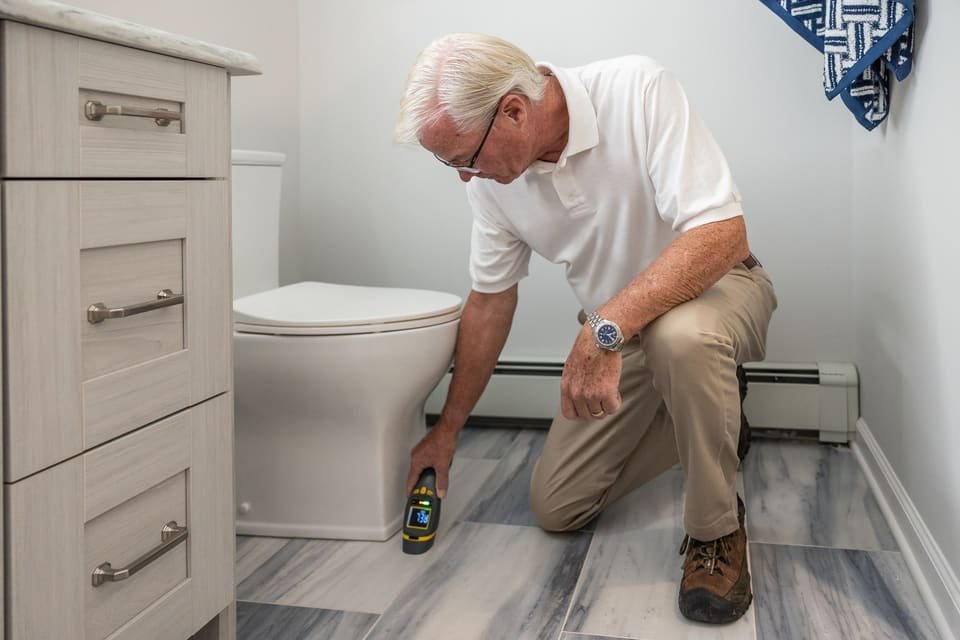
Hidden leaks cost more in damage than in plumbing. The work is locating the source accurately before opening a wall or a floor, so the repair is made where the failure actually is.
Non-invasive leak detection
Water main leak detection
Underground pipe leak location
Pinhole leak repair
Burst pipe emergency repair
Full and partial repiping
Polybutylene pipe replacement
Copper and PEX repiping
Service guide
What to Know Before Booking Leak Detection & Pipe Repair
Recognising a hidden leak, how it gets located without opening every wall, and what the repair options are once it is found.
What a Hidden Leak Looks Like Before You See Water
The expensive leaks are the ones that never surface. Water tracks along joists and behind finishes and shows up somewhere unrelated to the failure, or it does not show up at all until there is structural damage or mould. The early signals are usually indirect: a water bill that moved without a change in habits, a meter that creeps with everything shut off, a warm patch on a floor, a musty smell in one room.
If the meter registers flow with every fixture closed and the main into the house is the only thing open, water is going somewhere. That single test is the most useful thing a homeowner can do before calling, and it tells us a great deal about where to start.
Water bill increase with no change in usage
Meter registering flow with all fixtures off
Damp drywall, staining, or bubbling paint
A warm spot on a floor over a hot line
Persistent musty odour in one area
Locating It Without Opening Everything
The objective is to open the wall once, in the right place. We work from the meter and isolation valves to narrow which branch is losing water, then use acoustic listening, thermal differences, and moisture mapping to localise the point of failure before anything is cut.
Isolation is underrated as a diagnostic step. Closing valves in sequence and watching the meter can separate the supply side from the fixtures and the hot side from the cold, often narrowing an entire house down to one run before any equipment comes out of the van.
Pinhole Leaks Are Rarely a One-Off
A pinhole in copper is caused by conditions inside the pipe, not by bad luck at that spot: water chemistry, high flow velocity at bends, and residual flux from the original install all contribute. The important implication is that the conditions which produced one pinhole exist throughout the system.
So when a copper system produces its second or third pinhole in a couple of years, patching the next one is not a strategy. That is the point at which a broader repipe conversation is the honest recommendation, and we will say so rather than selling you another spot repair.
Repair, Section Replacement, or Repipe
A single failure on an otherwise sound system is a repair. Repeated failures in the same run mean replacing that run. Failures appearing in different parts of the system mean the material itself is at end of life, and that is a repipe.
Poly-B systems are a category of their own because the degradation happens invisibly inside the pipe wall throughout the whole system at once. If the house has Poly-B, the assessment is different and we cover it on its own page.
Homeowner guides
Leak Detection & Pipe Repair Guides
Longer answers to the questions that come up most on leak detection & pipe repair calls.