
Resource Guide
How to Prevent Frozen Pipes in Metro Vancouver
A homeowner's guide to protecting pipes during Lower Mainland cold snaps, including hose bibs, crawl spaces, and emergency shutoff steps.
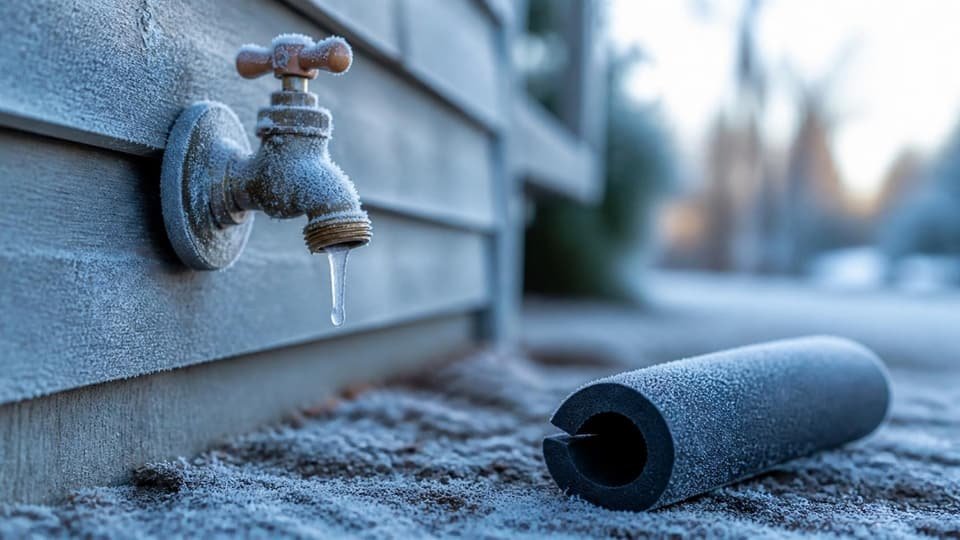
Metro Vancouver winters are usually mild, which is exactly why frozen pipes catch people off guard. A few nights below freezing can expose weak spots in crawl spaces, garages, exterior walls, and outdoor hose bibs.
The best prevention work happens before the first cold snap. The second-best time is the day a freeze warning appears, before everyone is trying to buy the same pipe insulation.
Why Pipes Burst
Water expands as it freezes. When water is trapped inside a pipe, hose bib, or valve, that expansion creates pressure. The pipe may split while frozen, but the water damage often appears later when the ice thaws and water starts moving again.
Where to Look First
Walk the house and look for plumbing exposed to cold air:
- outdoor hose bibs
- garage water lines
- crawl space piping
- unfinished basement piping
- pipes inside exterior walls
- unheated utility rooms
- laundry rooms against exterior walls
Homes in Vancouver, Burnaby, New Westminster, and older Surrey neighbourhoods can have plumbing that was never planned for long cold snaps. Newer homes can have issues too, especially where a pipe runs through a garage, a crawl space, or a poorly sealed wall cavity.
The Hose Bib Deserves Its Own Paragraph
Outdoor taps cause more Lower Mainland freeze damage than anything else, and the reason is that the damage is invisible until spring.
There are two kinds. A standard sillcock has its valve seat right at the outside wall, so any water left in it is sitting in the coldest part of the assembly. A frost-free sillcock has a long stem that places the valve seat well inside the heated envelope, and the barrel is pitched to drain when you close it.
The frost-free version only works if two conditions hold: the hose is disconnected, and the pitch is correct. A hose left attached traps water in the barrel and defeats the entire design — which is why “but I have frost-free taps” is not a reason to leave the hose on.
If your home has interior shutoffs for the outdoor taps, close them in the fall and open the outside tap to drain the line. If you do not know whether you have them, look for a small valve on the pipe feeding each hose bib, usually in the basement or crawlspace, sometimes with a small bleed cap.
The failure pattern is consistent: the barrel splits during the freeze while the valve is closed, so nothing leaks. In April someone turns the tap on for the first time, and water pours into the wall cavity behind it. If you had a freeze this winter, test each outdoor tap early in the spring while you are standing there watching it.
A 30-Minute Cold Snap Checklist
1. Disconnect Garden Hoses
Leaving a hose connected can trap water at the exterior faucet. Disconnect hoses before winter, drain them, and store them away. This is one of the simplest fixes and one of the easiest to forget.
2. Insulate Exposed Pipes
Foam pipe insulation is inexpensive and useful in crawl spaces, garages, and unfinished areas. Pay attention to drafts near vents, rim joists, and exterior penetrations. Insulation helps most when the pipe is also protected from moving cold air.
3. Keep Heat Moving
During a cold snap, keep indoor heat on and open cabinet doors below sinks on exterior walls. If you are away, do not shut the heat off completely. A minimum indoor temperature around 12 deg C is a practical baseline.
4. Seal Obvious Drafts
If cold air is blowing directly onto a pipe, insulation alone may not be enough. Close crawl space vents where appropriate, seal obvious gaps, and keep garage doors closed.
5. Know Your Main Shutoff
Find the main water shutoff before there is an emergency. Make sure everyone in the home knows where it is and how to close it.
If You Are Leaving the House Empty
This is where a mild-winter region gets caught out, because people travel over the holidays and that is exactly when the cold arrives.
- Do not turn the heat off. Set back, do not shut down. Around 12 °C is a practical floor.
- Open cabinet doors under sinks on exterior walls so room air reaches the piping.
- Ask someone to check the house if you will be away more than a few days. A leak found on day two is a repair; the same leak found on day fourteen is a restoration project.
- Consider closing the main shutoff for longer absences, and draining the system down if the house will be empty for weeks. If you have a heating system with a boiler, take advice before draining anything, because a hydronic system is not a domestic water system.
- Know whether your insurance has an occupancy or heat requirement. Many policies do, and an unoccupied house with the heat off can complicate a claim.
If a Pipe Freezes
If a faucet only produces a trickle during freezing weather:
- Shut off the main water supply if you suspect a burst pipe.
- Leave the affected faucet open.
- Warm exposed pipe gently with warm towels or a hair dryer.
- Never use a torch or open flame.
- Call a plumber if the frozen section is hidden, inaccessible, or already leaking.
After the Cold Snap
Once temperatures rise, check the areas you were worried about. Look for damp drywall, water stains, soft flooring, musty smells, or a water meter that keeps moving when fixtures are off. A pipe can split during the freeze and reveal itself only after thawing.
A sudden change in water pressure or flow after a cold snap is worth taking seriously for the same reason. So is any home on Poly-B supply piping, which is less forgiving of a freeze than copper.
For active leaks, burst pipes, or hidden water damage, Mavi Mechanicals provides leak detection and pipe repair across Vancouver, Burnaby, Surrey and the wider Lower Mainland. Call (604) 614-0121 for urgent help.