How to Tell If Your Home Has Poly-B
Polybutylene was installed in Canadian homes from roughly the late 1970s through the 1990s. In the Lower Mainland it turns up constantly in subdivisions built across Surrey, Langley, Abbotsford, and the Tri-Cities during that stretch. It is usually a flexible grey pipe, sometimes blue or black, joined with plastic or copper crimp fittings.
The easiest places to look are the ones nobody finishes: beside the hot water tank, under bathroom and kitchen sinks, and at the main shutoff. The pipe is often stamped PB2110. If you find grey flexible pipe at the tank but copper at the fixtures, the home may have been partially repiped already, which changes the scope considerably.
- Flexible grey, blue, or black pipe rather than rigid copper
- Stamped PB2110 along the length of the pipe
- Plastic or copper crimp rings at each joint
- Visible at the water tank, under sinks, and at the main shutoff
- Common in homes built between the late 1970s and late 1990s
Why Poly-B Fails, and Why It Fails Without Warning
Two things go wrong. The fittings can fail at the crimp, and the pipe itself degrades from the inside as oxidants in treated municipal water attack the material over years. The second one is the problem, because the damage is internal. A line can look perfectly sound from the outside and still be near the end of its service life.
That is why Poly-B failures tend to show up as a sudden burst rather than a slow drip you catch early. The practical question is not whether a given section is leaking today. It is how much service life is left across the whole system, and whether it is worth continuing to pay for spot repairs on pipe that is aging everywhere at once.
Insurance, Inspections, and Resale
Poly-B has become a standard question on home insurance applications and renewals in British Columbia. Insurers treat it differently from one another: some ask and move on, some apply conditions or higher premiums, and some decline the risk. Confirm how your own insurer handles it before assuming your coverage is unaffected.
It also comes up in home inspections. Buyers and their inspectors know the material by sight, and an outstanding Poly-B system is a recurring negotiating point. If you are planning to sell, a documented repipe with a pressure test on file removes the issue from the conversation instead of leaving it to be priced into an offer.
What a Repiping Project Actually Involves
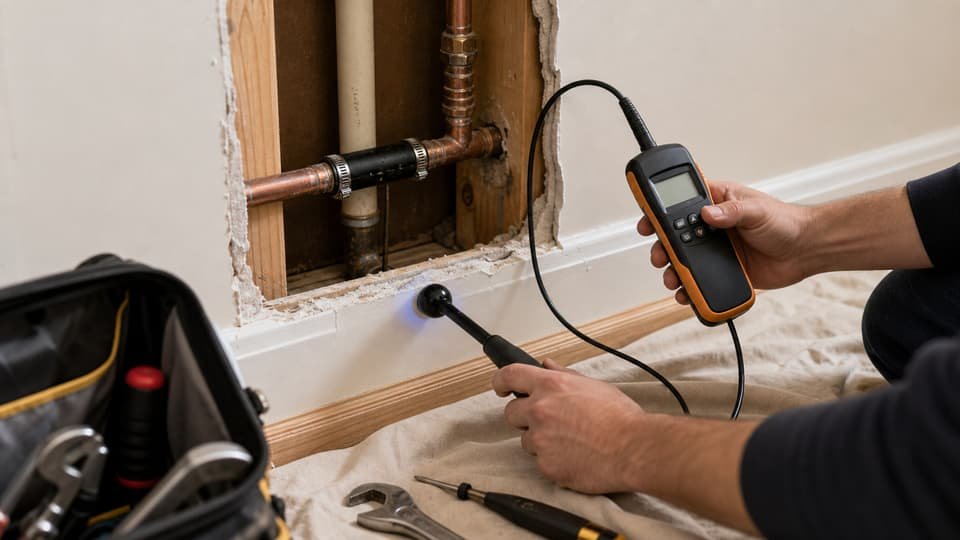
Most of the work is access, not pipe. New PEX or copper is routed to every fixture, which means opening drywall at strategic points, running lines through walls, ceilings, and joist bays, and reconnecting each fixture before pressure testing the system. The number of bathrooms, the number of storeys, and whether the ceilings are finished drive the scope far more than the square footage does.
We walk the property first and map the route before quoting, so you know where access holes will go and what will need patching afterward. Some households stay in the home during the work and some do not; that depends on how many fixtures are offline at once and for how long. We confirm the staging plan before starting rather than after.
- Fixture count and number of storeys, not floor area
- Finished versus unfinished ceilings and crawlspace access
- Whether the main, branch lines, or both are being replaced
- Drywall patching and paint, which are usually a separate trade
- Occupancy during the work and how long fixtures stay offline
Repiping Strata Units and Townhouses
In a strata, the boundary between suite plumbing and common property decides who approves the work and who pays for it. Lines inside your unit are typically yours; risers and shared mains usually are not. That distinction is set by the strata plan and bylaws, not by a general rule, so it has to be checked for each building.
Whole-building repipe projects run on a different timeline entirely, since they usually need a depreciation report, a funding decision, and an approval vote before any scheduling happens. We can scope and quote at the unit level or work with a council or property manager on a building-wide plan.
Need help with this service? Call the 24/7 line for urgent issues or send the property details for a scheduled quote.