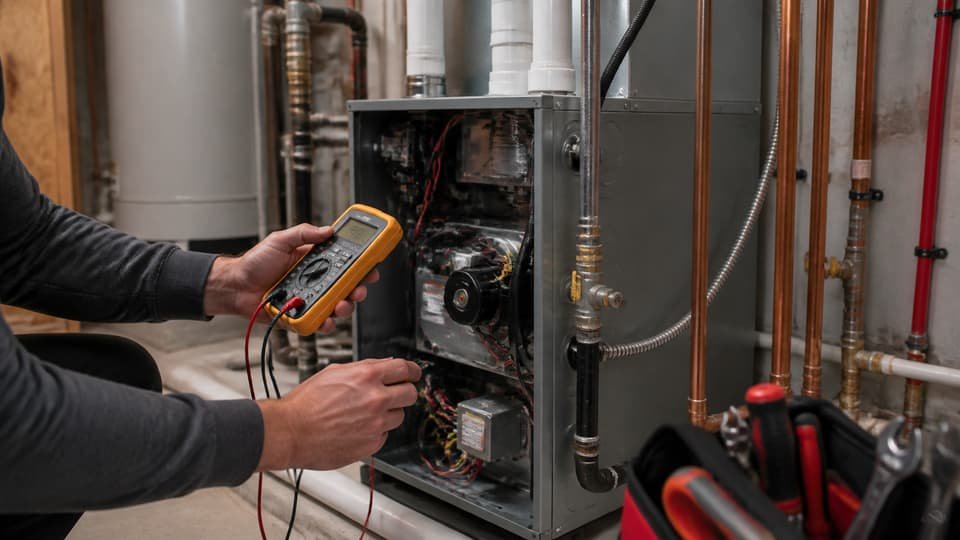
What the Symptoms Usually Point To
Boilers tend to announce problems before they quit. Pressure that keeps dropping points at a leak somewhere in the loop or a failing expansion tank. Banging and kettling noises usually mean scale or circulation problems rather than a boiler that is about to explode. Heat in some rooms and not others is more often a zone valve, circulator, or air-lock issue than a boiler capacity problem.
That distinction matters because the fixes differ enormously in cost. Diagnosing the symptom properly can be the difference between a circulator replacement and a conversation about a new boiler. We check the actual fault before quoting equipment.
- Pressure dropping repeatedly: leak in the loop or expansion tank failure
- Banging or kettling: scale buildup or restricted circulation
- Some zones cold: zone valve, circulator, or trapped air
- Short-cycling: control, sizing, or flow problem
- Relief valve discharging: pressure or expansion tank fault
Repair or Replace
Age alone is not the deciding factor. What matters is whether the failed component is economically replaceable, whether the heat exchanger is sound, and whether repairs have started stacking up season after season. A well-maintained older boiler with one failed circulator is a repair. A unit with a compromised heat exchanger and a history of annual faults is a replacement conversation.
Efficiency is the other half of it. Older atmospheric boilers operate well below what a modern condensing unit achieves, so on a system that is genuinely near end of life the operating cost difference is part of the decision rather than a sales line. We give you the actual condition of the equipment and let the numbers sit alongside each other.
Combi, System, and Condensing Boilers
A combi boiler produces heat and domestic hot water from a single unit with no separate tank, which suits smaller homes and units where mechanical space is tight. A system boiler works with a separate hot water cylinder and handles higher simultaneous demand better, which matters in larger homes with several bathrooms in use at once.
Condensing boilers recover heat from flue gases that a conventional boiler sends outside, which is where the efficiency gain comes from. They need appropriate venting and a condensate drain, and that requirement is the practical constraint in a retrofit. We confirm venting routes and condensate disposal during the assessment, since those determine whether a straight swap is realistic or whether the installation needs rework.
Radiant and In-Floor Systems
Hydronic radiant heating shows up throughout the Lower Mainland, in older Vancouver and Port Moody homes with cast iron radiators and in newer builds with in-floor tubing. Both are comfortable systems that reward proper commissioning and suffer quietly when they do not get it.
Common faults are trapped air, failed circulators, manifold and zone control problems, and mixing valve failures that let floor temperatures run outside their intended range. Diagnosis usually means working through the distribution system rather than starting at the boiler, because the boiler is frequently the healthiest part of the system.
Gas Work Requires a Licensed Gas Fitter
Gas-fired boiler installation, replacement, and any work on the gas connection is licensed work in British Columbia, permitted and inspected through Technical Safety BC. That is not a formality. Improper venting or combustion air on a gas appliance is a carbon monoxide risk, and a boiler runs unattended in a mechanical room for months at a time.
If you smell gas, leave the building and call from outside. Do not operate switches on your way out. Our 24/7 line handles gas-related heating emergencies.
Need help with this service? Call the 24/7 line for urgent issues or send the property details for a scheduled quote.