
Resource Guide
Boiler Short Cycling and No-Heat Faults: Reading the Symptoms
How to tell short cycling from normal operation, what pressure and circulation faults look like, and what to observe before calling for boiler service in BC.
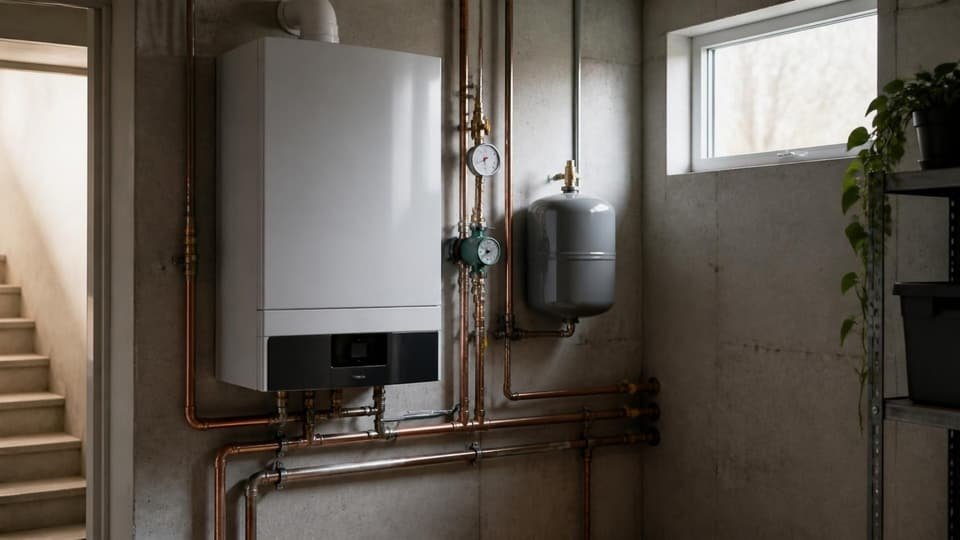
Boilers fail differently from furnaces. A furnace usually either makes heat or does not. A boiler can run continuously, make its usual noises, and still leave half the house cold — because the problem is not combustion, it is circulation.
Knowing which of those you are dealing with changes what you tell us on the phone, and often changes how urgent the call is.
Short Cycling: Count the Firings
Short cycling means the burner lights, runs briefly, shuts off, and repeats — far more often than it should.
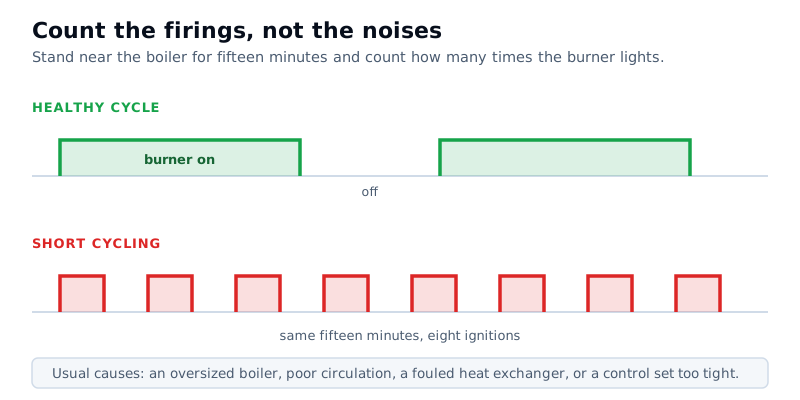
This matters for real reasons, not just efficiency. Ignition is the hardest thing a boiler does. Every cycle is wear on the igniter, the gas valve, and the heat exchanger. A boiler firing eight times in fifteen minutes is doing roughly a season’s worth of ignitions in a month.
Why It Happens
The boiler is oversized for the load. The most common cause, and the most frustrating, because the fix is either modulation settings or replacement. An oversized boiler satisfies its target temperature almost instantly, shuts down, and restarts as soon as the water cools. It happens when equipment was sized by rule of thumb, or when a house was insulated and its heat loss dropped without the boiler being reconsidered.
Poor circulation. If water is not moving through the system properly, the boiler heats a small volume very quickly, hits its limit, and shuts off — while the radiators or in-floor loops stay cold. Causes include a failed circulator pump, a closed or seized zone valve, or air trapped in the system.
Air in the system. The classic, and often fixable. Air pockets block flow the same way a blockage would. Gurgling, banging, or radiators that are hot at the bottom and cold at the top all point here.
A fouled heat exchanger. Scale or sediment on the water side insulates the exchanger. The boiler senses high temperature at the sensor while the system water stays cold.
Controls set too tight. A very narrow differential on the operating control makes the boiler cycle on small temperature swings. Sometimes this is simply a setting left at a default that does not suit the system.
System Pressure Is Worth Knowing
Your boiler has a pressure gauge. Learning to read it removes a lot of guesswork.
Most residential closed hydronic systems sit somewhere in the region of 12 to 15 psi when cold, rising modestly when hot — but check the label on your own equipment, because the correct range is set by the system, its height, and the manufacturer, not by a general figure.
Pressure too low commonly means a leak somewhere, an expansion tank that has lost its charge, or a fill valve that is not doing its job. A system that needs topping up repeatedly has a leak. Repeated manual filling is not maintenance; it introduces fresh oxygenated water every time, which accelerates corrosion inside the system.
Pressure too high usually means a waterlogged expansion tank or a fill valve passing water through. The relief valve will eventually discharge, which is it working correctly.
Photograph the gauge. Take a picture of the pressure gauge when the system is cold and again when it has been running. Two photographs tell a technician more than a paragraph of description, and they cost you nothing.
Cold Radiators or Cold Zones
If the boiler runs but heat does not arrive, work through where it stops.
One radiator cold, others fine. Usually air in that radiator, or a closed valve. Bleeding a radiator is within reach for most homeowners — open the bleed valve with the correct key, let the air out until water appears, close it, then check system pressure afterwards, because bleeding drops it.
A radiator hot at the bottom, cold at the top. Air at the top. Bleed it.
A radiator cold at the bottom, warm at the top. Sludge or sediment settled in the bottom. That is a system cleaning question, not a bleeding one.
A whole zone cold. Points at that zone’s valve, its thermostat, or its circulator rather than the boiler.
Everything cold, boiler running. Circulation has failed somewhere central — the main circulator, a system-wide air lock, or a control fault.
In-floor radiant that never quite warms up. Radiant is one of the hydronic systems we see most often in Port Moody and North Burnaby homes.
Radiant systems are slow by design and are meant to run at low water temperature continuously, not in bursts. A radiant system being controlled like a radiator system will always feel disappointing. That is a setup question rather than a fault.
Noises and What They Usually Mean
- Gurgling or trickling — air in the system
- Banging or hammering on startup (“kettling”) — scale on the heat exchanger causing localised boiling
- A rhythmic click-whoosh every few minutes — the ignition sequence, i.e. short cycling
- Humming that stops when the heat call ends — circulator noise, often a failing bearing
Where to Stop
Gas boilers are regulated appliances in British Columbia. Bleeding a radiator and reading a gauge are fine. Anything involving the burner, the gas valve, the venting, or the combustion chamber must be done by a certified gas fitter, or under one's direct supervision.
If you smell gas: leave the building and call the FortisBC 24-hour emergency line at 1-800-663-9911 or 911 from outside. Do not operate switches or phones indoors on the way out.
Also treat these as stop-and-call situations:
- Water visibly leaking from the boiler or its piping
- A relief valve discharging repeatedly
- Any soot, scorching, or unusual smell around the appliance
- A carbon monoxide alarm sounding — leave first, call from outside
Repair or Replace
Boilers are long-lived when maintained, and replacing one is a significant project, so the decision deserves better than a rule of thumb. The factors that actually matter:
- Availability of parts. A discontinued boiler with no parts supply is finished regardless of its condition.
- Heat exchanger condition. This is the boiler. A cracked or heavily scaled exchanger usually ends the conversation.
- How many repairs, how recently. Three calls in two seasons is a pattern.
- Whether the system around it is sound. Replacing a boiler onto a system full of sludge buys you a shorter-lived new boiler.
- Whether the sizing was ever right. If short cycling is caused by oversizing, replacing like-for-like reproduces the problem.
If replacement is the direction, it is worth asking whether a heat pump belongs in the conversation, since hybrid and hydronic heat pump configurations now exist for exactly this situation.
Modern condensing and combi boilers have genuine advantages, but they are less tolerant of dirty system water than older cast-iron units. If a replacement is on the table, ask what the plan is for cleaning and treating the existing system. A quote that does not mention it is incomplete.
What to Have Ready When You Call
- How many times the burner fires in fifteen minutes
- The pressure gauge reading, cold and hot, ideally photographed
- Which rooms or zones are cold, and which are fine
- Any fault code on the display, written down exactly
- The make, model, and approximate age, from the label
- When it was last serviced
- Whether you have topped up the pressure recently, and how often
Mavi Mechanicals services boilers and hydronic systems across the Lower Mainland, with a 24/7 line for no-heat calls at (604) 614-0121.