
Resource Guide
Furnace Blowing Cold Air: What to Check, in Order
Four checks a Lower Mainland homeowner can safely make before calling for furnace service, and the point where the remaining causes need a licensed gas fitter.
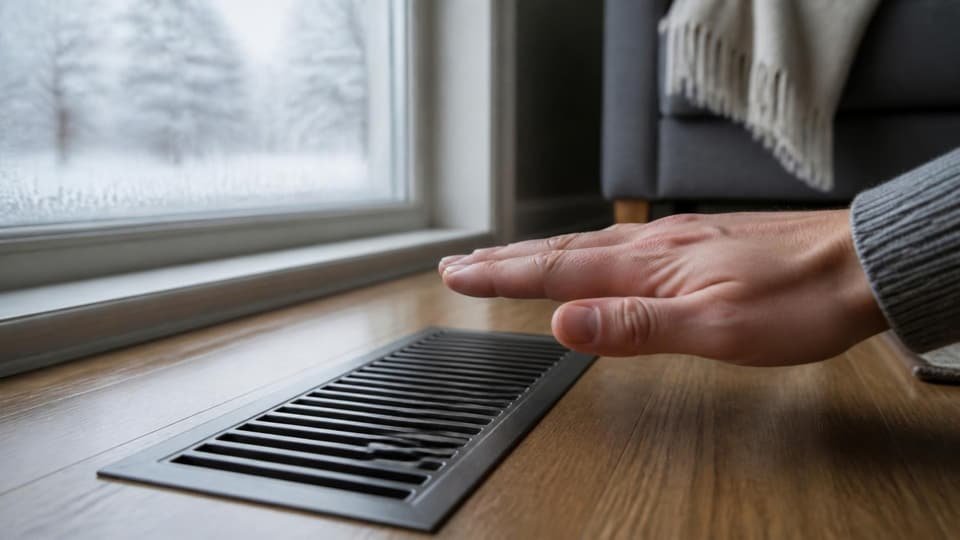
The blower is running. Air is coming out of the vents. It is just not warm. This is one of the most common heating calls of the Lower Mainland winter, and a meaningful share of them turn out to be something the homeowner could have resolved in ten minutes.
The trick is working through it in the right order, and knowing exactly where to stop.
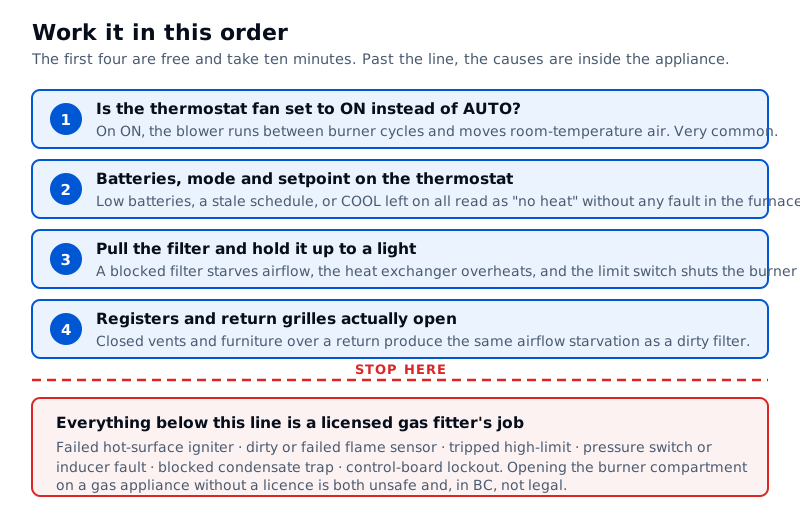
1. Is the Fan Set to ON Instead of AUTO?
Start here, because it is genuinely the most common answer and it takes five seconds.
On AUTO, the blower runs only while the burner is producing heat. On ON, the blower runs continuously — including during the long gaps between burner cycles, when all it can move is room-temperature air. To someone standing at a vent, a correctly functioning furnace on ON feels exactly like a broken one.
Set it to AUTO and wait for a full cycle. If the air is warm when the burner runs, nothing is wrong.
Some people deliberately run the fan continuously for air circulation or filtration. That is a legitimate choice. Just know that it makes the vents feel cool most of the time.
2. Thermostat Batteries, Mode, and Setpoint
Three separate things live here and any of them produces the same complaint.
Batteries. A thermostat with weak batteries can hold a display and still fail to close the call for heat. If the screen is dim, flickering, or showing a low-battery indicator, change them before anything else.
Mode. COOL left on from summer, or a smart thermostat that switched itself, means the furnace is never being asked to fire.
Schedule. Programmable and smart thermostats run setbacks. A schedule built around a household routine that has since changed — someone now works from home, the kids’ hours moved — will cheerfully hold the house at its overnight temperature in the middle of the afternoon. Check the current setpoint against the room temperature, not against what you think the schedule says.
3. Pull the Filter and Hold It Up to a Light
If you cannot see light through it, it is finished.
A restricted filter is not a minor efficiency issue. It starves the furnace of the airflow it needs to carry heat away from the heat exchanger. The heat exchanger overheats, the high-limit switch does its job and shuts the burner down, and the blower keeps running to cool the thing off. The result at the vent is cold air — from a safety device working correctly.
Lower Mainland notes on filters:
- One inch pleated filters in a heavily used house often need replacing every two to three months, not every season.
- Construction dust, renovations, and wildfire smoke seasons all shorten filter life sharply.
- A higher MERV rating is not automatically better. A filter too restrictive for the blower creates the exact problem above. Match the filter to what the equipment is rated for.
- Put the replacement date on the filter frame in marker. It removes the guesswork entirely.
4. Registers and Return Grilles Actually Open
Closed supply registers and blocked return air do the same thing a dirty filter does — they restrict airflow until a safety device intervenes.
Walk the house. Look for registers closed over winter, furniture moved onto a return grille, a rug covering a floor vent, and boxes stacked against the furnace return in the basement. Closing vents in unused rooms is a common piece of folk energy advice, and on most residential systems it makes things worse rather than better.
Stop Here
If the fan is on AUTO, the thermostat is calling for heat with fresh batteries, the filter is clean, and the airflow path is open — and you are still getting cold air — the cause is inside the appliance.
The burner compartment of a gas furnace is not homeowner territory in British Columbia. Regulated gas work must be performed by a certified gas fitter, or under a gas fitter's direct supervision. This is not a formality; the failure modes involve combustion, flue gases, and carbon monoxide.
If you smell gas: leave the building, and from outside call the FortisBC 24-hour emergency line at 1-800-663-9911 or 911. Do not use light switches, phones, or anything else that could create a spark on your way out.
What a Technician Will Be Looking At
Useful to know, because it tells you what to describe on the phone.
Hot surface igniter. A consumable part. It glows to light the burner and eventually cracks or loses resistance. Very common on furnaces past about ten years.
Flame sensor. A thin rod that proves flame is present. As it oxidises, the control board stops seeing flame and shuts the gas valve within a few seconds of ignition. The classic symptom is a furnace that lights, runs briefly, and quits — repeatedly.
High-limit switch. Already discussed. If it is tripping with a clean filter and open vents, something else is restricting airflow, or the blower itself is failing.
Pressure switch and inducer. These confirm the flue is drawing properly before gas is allowed to flow. A blocked intake or exhaust — bird nest, snow, a crushed vent — stops the sequence before it starts.
Condensate trap. High-efficiency furnaces produce acidic condensate. A blocked trap or drain triggers a safety shutdown and is a frequent cause of a mid-winter no-heat call.
If the symptoms point at a boiler rather than a forced-air furnace, our guide on boiler short cycling and no-heat faults covers that system instead.
Control board lockout. After a set number of failed ignition attempts, the board locks out and stops trying. Many boards flash a diagnostic code through a small window. If you can see a flashing LED, count the pattern and tell us. It narrows the diagnosis before anyone arrives.
What to Have Ready When You Call
- Whether the blower runs at all, and whether it runs constantly
- Whether you hear the burner attempt to light, and for how long it stays lit
- Any flashing code at the furnace, counted
- The approximate age of the furnace and when it was last serviced
- Whether the thermostat is calling for heat
- Whether anything changed recently — a new thermostat, a renovation, a power outage
About Repeat No-Heat Calls
If a furnace has had three service calls in two winters, the useful conversation is no longer about the next part. At that point the questions are the age of the heating equipment, the condition of the heat exchanger, and whether continuing to replace components is good money.
That is also the moment to look at whether a heat pump makes sense for your house, since the Lower Mainland climate suits them well and there are BC rebate programs for the switch. Our guide on heat pump sizing covers what actually determines whether that works.
Mavi Mechanicals provides furnace repair, maintenance, and replacement across the Lower Mainland, with a 24/7 line for no-heat calls at (604) 614-0121.