
Resource Guide
Heat Pump Sizing in the Lower Mainland: Why the Calculation Beats the Brand
What a CSA F280-12 heat loss calculation is, why the balance point decides your comfort and your bills, and what BC rebate programs require before you install.
Most heat pump conversations start with the wrong question. People ask which brand is best, or how many tons they need, or whether cold-climate models really work here. Those are downstream questions. The one that actually determines whether you end up happy is: how much heat does this specific house lose, at the coldest temperature it has to cope with?
Get that number right and a mid-range unit will keep you comfortable and your bills predictable. Get it wrong and the most expensive equipment on the market will disappoint you.
What a Heat Loss Calculation Is
A heat loss calculation works out, in kilowatts or BTU per hour, how fast your house sheds heat to the outdoors at a specified design temperature. It accounts for wall and ceiling insulation, window area and type, air leakage, floor construction, orientation, and the local design temperature for your area.
In Canada the standard method is CSA F280-12, performed in verified software. It is not a rule of thumb, and it is not square footage times a multiplier.
This is worth insisting on, because rule-of-thumb sizing is how most equipment gets specified and it fails in both directions:
- Oversized. The unit satisfies the thermostat quickly, shuts off, and repeats. Short cycling wastes energy, wears components, and — in cooling mode — leaves the house cold and clammy because the coil never runs long enough to remove humidity.
- Undersized. Backup electric resistance heat carries the load on cold days. It works, but resistance heat is the expensive way to make heat, and it turns a good decision into a bad hydro bill.
The Balance Point Is the Number That Matters
Here is the thing that rule-of-thumb sizing cannot capture. A heat pump’s output falls as it gets colder outside, at exactly the same time your house’s heat loss rises.
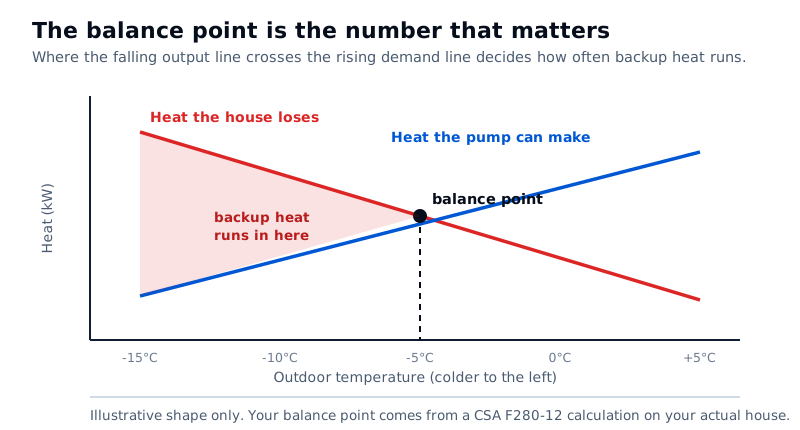
The temperature where those two lines cross is the balance point. Above it, the heat pump handles everything on its own. Below it, something else has to make up the shortfall — electric resistance elements, or a gas furnace in a hybrid system.
The Lower Mainland is a genuinely good climate for this. Our design temperatures are mild by Canadian standards, so a properly specified system spends the overwhelming majority of the heating season above its balance point. That is the whole reason heat pumps make more sense here than they do in most of the country.
But “properly specified” is doing real work in that sentence, and it comes from the calculation.
What BC Rebate Programs Actually Require
This is where the calculation stops being a best practice and becomes a condition of getting paid.
BC’s rebate programs have specific requirements that catch people out:
- A CSA F280-12 heat load calculation may be required to confirm the system is adequately sized, completed in verified software at the home’s design temperature, with a summary form.
- A sizing performance floor. At a minimum the installed heat pump must be sized to meet 100% of the home’s heating requirement, maintaining 22°C throughout the home at an outdoor temperature of −5°C or colder, without using electric resistance heat.
- Registered contractor requirement. The work must be done by a contractor who is an active member of the Home Performance Contractor Network at the time of installation. If they are not, the application is rejected — not reduced, rejected.
- A submission deadline. The application and supporting documents must be submitted by the registered contractor within six months of the invoice date.
Verify the current program rules before you commit to anything. Rebate amounts, eligibility, equipment lists, and program membership all change. We deliberately do not publish rebate dollar figures, because a number that was right last quarter is worse than no number at all. Start at CleanBC Better Homes, BC Hydro, and FortisBC.
Our separate guide on BC heat pump rebates covers the sequencing in more detail. The short version: confirm the program before the old system comes out, not after.
Electrical Capacity Is the Usual Constraint
In practice, the thing that most often complicates a Lower Mainland heat pump project is not the heat pump. It is the electrical panel.
A heat pump plus backup resistance heat plus whatever else the house already runs — an EV charger is the common one now — can exceed the capacity of an older 100-amp service. The options are a service upgrade, a load management device, or a hybrid configuration that keeps the gas furnace as backup and dodges the resistance heat load entirely.
This needs to be established during the quote, not discovered during installation. An electrical load calculation belongs in the scope alongside the heat calculation.
Ducted, Ductless, or Hybrid
| Configuration | Suits | Watch for |
|---|---|---|
| Ducted (central) | Homes with existing ductwork in reasonable condition | Duct sizing done for a furnace may not suit a heat pump's higher airflow at lower temperature |
| Ductless (mini-split) | Homes with baseboards, radiant, or no ducts; additions and suites | Heat only reaches where there is a head. Closed doors and hallways matter |
| Hybrid / dual fuel | Homes keeping a serviceable gas furnace as the cold-weather backup | The changeover setpoint has to be configured deliberately, not left at a default |
A ducted retrofit deserves particular attention. Heat pumps deliver a larger volume of air at a lower temperature than a furnace does. Ductwork that was marginal for a furnace can become audibly and noticeably inadequate. Checking static pressure on the existing system before quoting is the difference between a good install and a noisy one.
Questions Worth Asking Any Installer
- Will you perform a CSA F280-12 heat loss calculation, and will I receive a copy?
- What balance point does that calculation give for the equipment you are proposing?
- Are you an active Home Performance Contractor Network member right now?
- Have you done an electrical load calculation on my panel?
- For a ducted system, have you measured static pressure on the existing ductwork?
- Who submits the rebate paperwork, and by when?
An installer who cannot answer the first two is sizing by rule of thumb. That is worth knowing before you sign.
Removing or Keeping the Gas Furnace
Not a simple question, and the right answer depends on your priorities rather than on ideology.
Keeping it as hybrid backup gives you resilience, avoids the electrical upgrade in many cases, and means the coldest handful of days each year cost less to heat. Removing it ends the gas connection charge, frees the space, and is required by some full-electrification incentive streams.
If the furnace is old enough that it will need replacing within a few years anyway, keeping it as backup is deferring the decision rather than making one. Worth being clear-eyed about that.
What to Have Ready
- The approximate age and square footage of the house, and whether it is over a crawlspace, basement, or slab
- What heats it now, and roughly what that costs
- Whether ductwork exists and where the furnace is
- The size of your electrical service, from the main breaker
- Any insulation or window upgrades done since it was built
- Whether a rebate is part of the plan
Mavi Mechanicals installs and services heat pumps across the Lower Mainland, including Surrey, Langley, and Burnaby. Call (604) 614-0121 to talk through what your house actually needs.