
Resource Guide
How to Tell If Your Home Has Poly-B Piping, and What to Do Next
A Lower Mainland homeowner's guide to identifying Poly-B water supply piping, understanding the insurance question, and deciding between partial and full repiping.
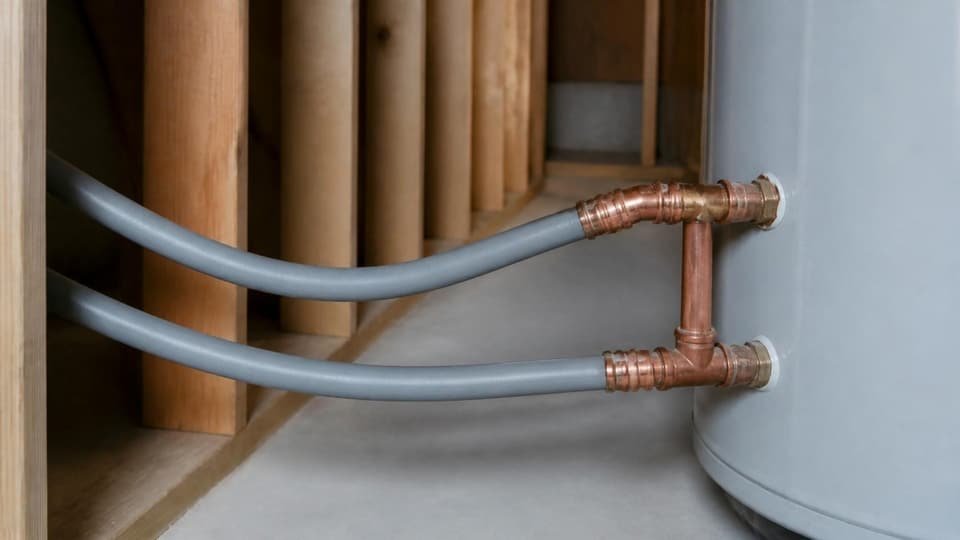
If you own a Lower Mainland home built or renovated between the mid-1980s and the late 1990s, there is a reasonable chance the water supply lines behind your walls are polybutylene — Poly-B. It went into an enormous number of houses, townhomes, and strata buildings across Surrey, Langley, Coquitlam, and the Fraser Valley during exactly the years this region was building fastest.
The question comes up in three situations: an insurance renewal asks about it, a home inspection flags it during a sale, or a pinhole leak appears and somebody says the word for the first time. In all three, the useful first step is the same. Find out what you actually have before you decide anything.
Start By Looking, Not By Guessing
Poly-B was installed in Canadian homes from roughly the late 1970s through the mid-1990s, and most heavily between about 1985 and 1997. It was removed from the Canadian plumbing code in 2005. If your home predates 1980 or postdates 2000, it is unlikely, though renovations complicate that.
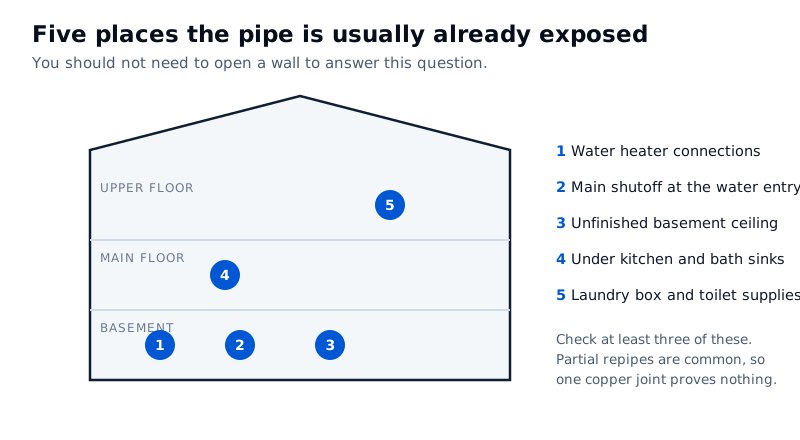
You should not need to open a wall to answer the question. Supply piping is already exposed in several ordinary places.
The Three Identifying Marks
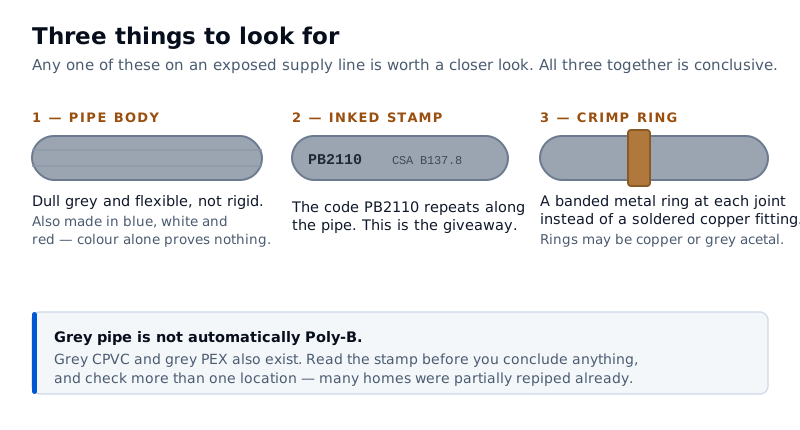
The pipe body. Poly-B is a flexible plastic pipe, usually dull grey. It was also produced in blue, white, and red, which is why “my pipes aren’t grey” is not a clearance.
The stamp. Look for inked printing repeating along the pipe. PB2110 is the resin code you are looking for, often alongside a CSA standard reference. This is the definitive marker.
The fittings. Instead of soldered copper joints, Poly-B uses a banded metal crimp ring at each connection. The rings themselves are worth noting: early installations used acetal (grey plastic) fittings that proved considerably more failure-prone than the later copper ones.
If you find grey pipe with no legible stamp, photograph it in good light and send the photo to a plumber rather than guessing. Stamps fade, and the difference between Poly-B and grey PEX matters a great deal to what happens next.
Why It Fails, and Why That Matters More Than Its Age
The usual explanation is that chlorine and other oxidants in treated municipal water degrade polybutylene from the inside out. Micro-fractures form in the pipe wall and propagate. Hot lines and lines running through warm spaces tend to go first, because the reaction accelerates with temperature.
The practical consequence is the thing worth understanding: Poly-B does not usually give you warning. There is often no slow drip, no stain on the ceiling, no rising water bill. A section that has been thinning for years fails at full line pressure, frequently inside a wall or above a finished ceiling, and frequently while nobody is home.
This is why the age question is not “how old is my plumbing” but “how much water can escape before somebody notices”. This is also why a slow decline in water pressure or flow is worth investigating rather than living with. A supply line failure in an occupied house at 2pm is a bad afternoon. The same failure in an empty townhome over a long weekend is a restoration claim with drywall, flooring, cabinetry, and — in a strata — your neighbours’ units.
Know where your main shutoff is, today. Whatever you decide about repiping, the single highest-value thing you can do this week is make sure every adult in the house can find and turn the main water shutoff in the dark. In most Lower Mainland homes it is near where the service enters, often in the garage, a crawlspace, or a utility room.
The Insurance Question
This is what drives most Poly-B calls, and it is also where the most confused information circulates.
The honest position: many BC insurers will still write a policy on a home with Poly-B, but terms vary widely between them and they change. Some ask about it and do nothing. Some load the premium. Some exclude water damage originating from supply piping. Some will bind coverage on the condition that the piping is replaced within a stated period. Some decline.
What that means for you:
- Do not assume you are uninsurable. Also do not assume you are covered.
- Read the water damage section of your own policy, not a forum post about somebody else’s.
- If you are buying, ask your broker before subject removal, not after.
- If you are quoted a condition like “replace within 12 months,” get that in writing with the exact deadline. That date, not your convenience, sets the project schedule.
Nobody can tell you what your insurer will do without reading your policy. Any contractor who states flatly that “insurance won’t cover Poly-B” is overreaching.
Repair, Partial Repipe, or Full Repipe
There are three real options and they suit different situations.
| Approach | Sensible when | The catch |
|---|---|---|
| Repair the failed section | A single failure, an otherwise dry house, and a decision to be made later | Every remaining metre is the same age and has had the same water through it |
| Partial repipe | Hot lines, an accessible run, or one floor where access is genuinely open | You will pay mobilisation and drywall twice if the rest follows later |
| Full repipe | Repeat failures, an insurance condition, a planned renovation, or a sale | Highest single cost, and the most disruption in one block |
We scope all three as Poly-B repiping work. The thing that usually decides it is not the pipe — it is the drywall. Most of the cost and nearly all of the disruption in a repipe is access and restoration, not the tubing. That is why doing it once, while walls are already open for a bathroom or kitchen renovation, is dramatically better value than doing it in two visits eighteen months apart.
If a renovation is on your horizon at all, sequence the repipe into it.
If You Are in a Strata or Townhome
A large share of Lower Mainland Poly-B sits in townhome complexes and low-rise stratas, and there the decision is not entirely yours.
Supply piping frequently runs through common property and between units. Whether a repipe is a personal project, a shared cost, or a building-wide capital project is set by the strata plan and the bylaws, not by a general rule. Getting that boundary confirmed in writing before any work is scoped saves the argument that otherwise arrives with the invoice.
Practically:
- Ask the strata for the depreciation report and any prior engineering assessment of the piping. Many BC buildings have already had this looked at.
- Confirm in writing who owns the pipe between the unit isolation valve and the riser.
- If the building is heading toward a full-building project, a unit-level repipe done now may be partly redundant. It may still be worth it for risk reasons, but you should decide that knowingly.
Our strata and property manager page covers how we scope this kind of work alongside councils.
What to Have Ready When You Call
If you can gather these, the first conversation gets much further:
- The year the home was built, and any known plumbing renovations
- Photos of exposed pipe, ideally including a legible stamp
- Whether you have had any leak, and where
- Whether the property is a house, townhome, or strata unit
- Anything your insurer or broker has said in writing
- Whether a renovation or sale is already planned
Where This Leaves You
Poly-B is a known, well-documented material with a known failure pattern. It is not an emergency the day you find it, and it is not something to leave indefinitely either. The sequence that serves people best is: identify it properly, read your own insurance position, find out whether a renovation is coming, and then decide once rather than three times.
Mavi Mechanicals assesses and repipes Poly-B across Surrey, Langley, Burnaby, and the wider Lower Mainland, for houses, townhomes, and strata units. If you have photos of what you found, call (604) 614-0121 and we will tell you what we think you are looking at.
Sources worth reading yourself
- Technical Safety BC for licensing and permit requirements on regulated work
- Your own insurance policy wording, specifically the water damage and supply piping sections
- Your strata’s depreciation report, if the property is part of a strata corporation