
Resource Guide
The Five Shutoffs Every Household Should Be Able to Find
A ten-minute walk around your home that will save you thousands the night something bursts, plus how to test each valve without breaking it.
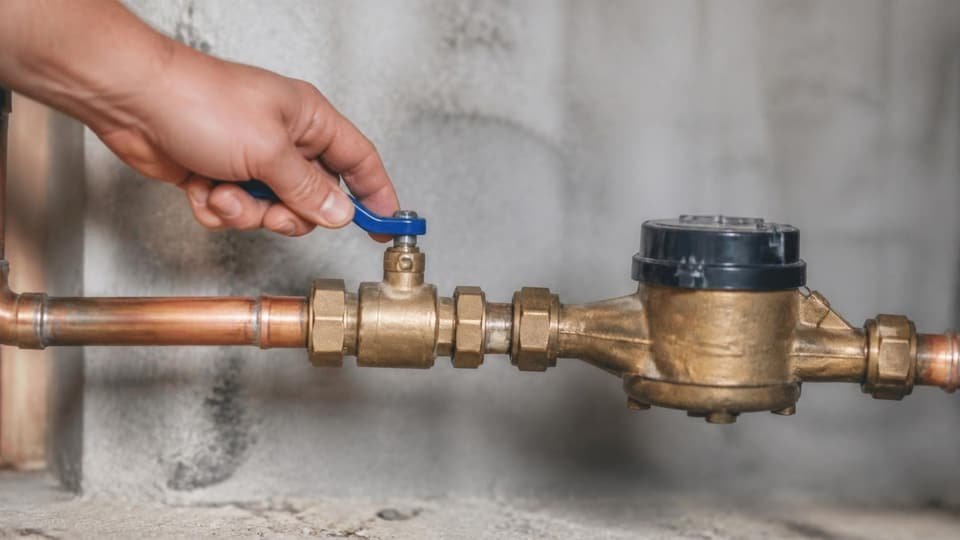
The difference between a repair and a renovation is usually about four minutes — how long it takes someone to find the shutoff.
We take emergency calls where the caller has been standing in water for twenty minutes because nobody in the house knew where the main valve was. The damage in those twenty minutes is frequently worse than the failure that caused it.
This takes ten minutes to do and it is worth doing this week.
The Five
1. The Main Water Shutoff
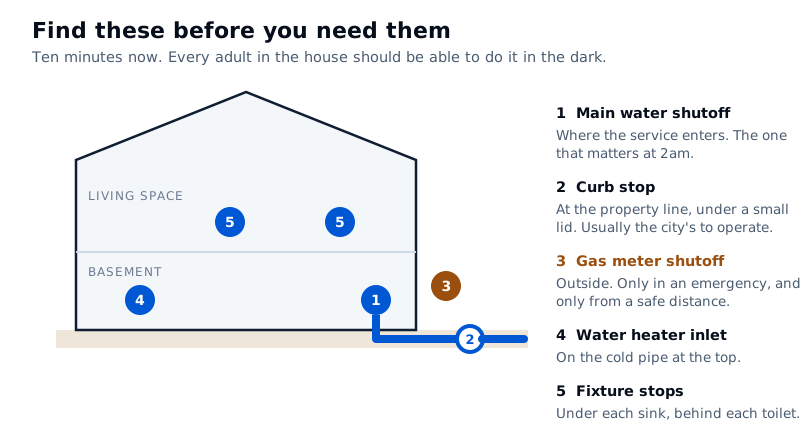
The one that matters. It stops all water entering the building.
Where to look: where the service enters the house — commonly a garage, a crawlspace, a utility or mechanical room, or under the stairs in a basement. In Lower Mainland homes it is usually on the street-facing wall at low level, often near the water meter.
What it looks like: either a round handle you turn clockwise several full turns, or a lever you turn a quarter turn so it sits across the pipe.
Test it. This is the part people skip. A valve that has not moved in fifteen years may not move when you need it, and finding that out during an emergency is the worst possible time. Close it fully, open a tap to confirm the water stops, then open it again fully and back off a quarter turn.
If it will not turn, is seized, or weeps when you move it, have it replaced before you need it. This is a small scheduled job and a large emergency one.
2. The Curb Stop
At or near the property line, usually under a small metal or plastic lid set into the ground.
This one is generally the municipality’s to operate, and many require it. It exists as the backstop when the main shutoff inside has failed. Know where yours is — under leaf litter, a parked car, or a new flower bed is where it usually turns out to be — and keep it clear and findable.
3. The Gas Meter Shutoff
Outside, at the meter, usually a lever on the pipe below the meter body.
This is an emergency-only valve, and there is a correct order of operations. If you smell gas, the first thing to do is leave the building — not to find a valve. Do not operate switches, phones, or anything that could spark on the way out.
From outside, call the FortisBC 24-hour emergency line on 1-800-663-9911 or 911. Close the meter valve only if you can do so safely from outside, and only if instructed. Once gas has been shut off at the meter, it must be turned back on and appliances relit by a qualified person — not by you.
Know where it is. Do not practise on it.
4. The Water Heater Inlet
On the cold pipe entering the top of the tank. It isolates the water heater without shutting off the rest of the house.
This is the valve you want when the tank itself is the problem — a leak from the tank body, a weeping relief valve, or a failed connection. Closing it and killing the power or gas to the unit buys you time to think.
5. Fixture Stops
The small valves under every sink and behind every toilet.
These are the ones that let you handle a running toilet or a leaking tap without shutting off water to the whole house. They are also the ones most likely to be seized, because they are twenty years old and have never been moved.
Worth doing: open and close each one once. If any will not move, or weeps afterwards, that is a small planned job now rather than a bad afternoon later. Old multi-turn stops in particular have a habit of failing at the packing nut the first time they are operated.
Make It Findable by Someone Else
Knowing where the valve is yourself is only half of it. The failure happens at 11pm while you are out of town.
- Label the main shutoff. A luggage tag and a marker. “MAIN WATER SHUTOFF — turn clockwise to close.”
- Photograph each valve and put the photos in a shared album or note the whole household can reach.
- Show everyone, including teenagers and anyone who house-sits for you.
- Keep the area clear. Storage stacked in front of the main shutoff is the most common reason a valve takes ten minutes to reach.
While You Are Down There
Two other things worth a look in the same ten minutes:
The water heater’s age, from the label. Tanks do not usually give warning before they fail, and a tank past its service life sitting on a finished floor is a known risk you can plan around.
Whether there is a drain pan under the tank, and whether it actually goes anywhere. A pan that drains nowhere is decoration.
What to Have Ready When You Call
If you have a leak right now:
- Whether you have been able to shut the water off, and at which valve
- Where the water is coming from, if you can see it
- Whether it is hot or cold water
- Whether it is near anything electrical
If you want a valve replaced before it becomes an emergency:
- Which valve, and where
- Whether it is seized, weeping, or just old
- The approximate age of the house
Mavi Mechanicals replaces main shutoffs, fixture stops and water heater isolation valves across Surrey, Vancouver, Burnaby and the wider Lower Mainland, and runs a 24/7 line for the calls where the valve did not turn: (604) 614-0121.