
Resource Guide
Copper Pinhole Leaks: Why Metro Vancouver's Water Causes Them
Metro Vancouver's water is soft and naturally acidic at source, which is why some older homes get pinhole leaks in copper. Why a water softener won't help.
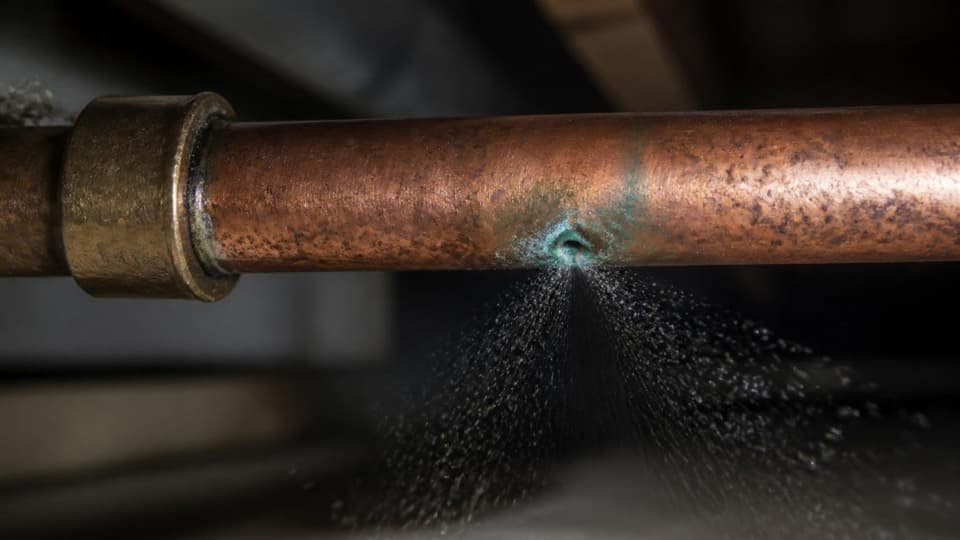
Metro Vancouver’s water is very soft. It comes from rain and snowmelt, carries almost no dissolved mineral, and starts out naturally acidic. For decades, water like that slowly corroded the inside of copper pipe, and in older homes the corrosion concentrates into pinhole leaks, usually inside a wall and rarely just one. Metro Vancouver has run a corrosion control program since the 1990s for exactly this reason, and made the treated water less acidic again in 2021. A water softener does nothing for it, because the water is already soft.
Hard Water and Soft Water Do Different Damage
Hard water is full of dissolved calcium and magnesium. It scales up kettles, furs the inside of water heaters, and coats shower glass. Annoying, visible, and the thing most plumbing advice on the internet is written about, because most of North America has it.
Harder, higher-pH water also lets copper build a stable protective film on its inner wall, partly its own oxide and partly mineral deposit. That film is a barrier between the water and the metal.
Soft, acidic, low-alkalinity water forms that film poorly, so the copper stays exposed.
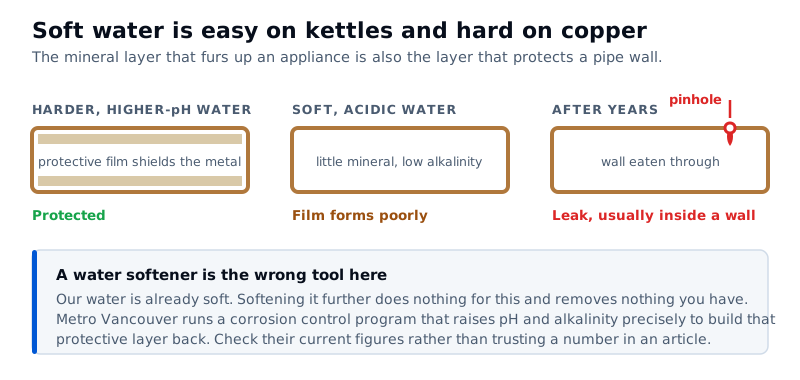
Over years, localised corrosion works at the unprotected inner surface. It does not thin the pipe evenly — it concentrates, and eventually opens a hole roughly the size of a pin. Full line pressure then pushes water through that hole continuously, usually somewhere inside a wall or above a ceiling.
The Symptoms, in Order of How Early They Appear
Blue-green staining around a tap, in a basin, or on a shower tray. That is dissolved copper coming out of solution. It is the earliest signal and the one most often dismissed as a cleaning problem.
A pinhole leak that seems to come from nowhere. No warning, no drip beforehand, no visible corrosion outside the pipe.
Then a second one, somewhere else, within a year or two. This is the part that matters.
Pinholes are rarely a one-off. The whole run has had the same water through it for the same number of years. When a second one appears in the same house, the conversation stops being about patching and starts being about how much of that piping to replace, and when.
Metro Vancouver Already Knows About This
Worth saying plainly, because it is the part that surprises people: the regional water utility treats this as a known issue and runs a corrosion control program specifically to address it.
The approach is to raise the pH and alkalinity of the supply using natural minerals, so the water becomes less aggressive toward copper and can form the protective layer it otherwise will not. In June 2021 it raised the target pH from 7.7 to 8.3–8.5 and roughly doubled alkalinity, to about 20 mg/L as calcium carbonate. Copper that spent decades in the older, more acidic water carries that history regardless.
Targets get revised, so check Metro Vancouver’s corrosion control page for the current figures.
Why a Water Softener Is the Wrong Purchase
It is a common and expensive mistake in this region.
A water softener removes calcium and magnesium. Our water has very little of either. Installing one here:
- does nothing about copper corrosion, because the problem is the absence of mineral, not its presence
- adds sodium to your water
- adds a unit that needs salt, maintenance and space
- costs money to buy and run
If a salesperson has told you a softener will stop pinhole leaks in Vancouver, Burnaby or Surrey, they are either selling from a script written for a hard-water market or they are not being straight with you.
What can be appropriate in specific situations is pH or alkalinity adjustment — genuinely different equipment, addressing the actual chemistry. That is worth a conversation, not a default purchase.
What Actually Helps
Get the water tested if you are unsure. Not a sales-led “free water test” from someone selling treatment equipment, whose result is known before they arrive.
Deal with the first pinhole properly. A pinhole leak repair is fine as a repair. But record where it happened and when, because the second one is the data point that matters.
Watch for early staining. Blue-green marks are your pipes telling you something before any water escapes.
Check pipe velocity if leaks cluster. Water moving too fast through undersized copper erodes the inner surface mechanically, and that accelerates everything above. Repeat failures on one specific run — rather than scattered around the house — often point here rather than at water chemistry alone.
Know the age of the plumbing. Copper installed in the 1960s and 1970s has had fifty to sixty years of this, most of it before the 2021 pH increase. That is not a reason to panic; it is a reason to plan rather than react.
Repipe or Repair
The honest answer is that it depends on how many failures you have had, where they were, and what else is happening to the house.
One pinhole in an accessible spot: repair it.
Two or more, or one inside a finished wall, or a house that is due for renovation anyway: get a proper assessment of the whole distribution system. Most of the cost of a repipe is opening and closing walls, not pipe — so doing it once, while something else already has the walls open, is dramatically better value than doing it in pieces over five years.
Repiping options include PEX, which is not subject to this failure mode at all, and re-running in copper with attention to sizing and velocity.
What to Have Ready When You Call
- The approximate age of the house, and whether it has ever been repiped
- Where the leak is or was, and whether there has been more than one
- Whether you see blue-green staining anywhere
- Whether the problem is on hot lines, cold lines, or both
- Whether any renovation is planned
Mavi Mechanicals does leak detection and pipe repair and repiping across Surrey, Vancouver, Burnaby, New Westminster and the wider Lower Mainland. Call (604) 614-0121.
Sources worth reading
- Metro Vancouver — corrosion control program, for current pH and alkalinity targets
- Your own municipality’s annual water quality report