
Resource Guide
Tankless vs Tank Water Heaters in BC: The Real Decision Factors
Venting, gas line capacity, condensate, and flow rate are what actually separate a tankless conversion from a tank replacement in Lower Mainland homes.
When a tank fails, the decision usually gets made in an afternoon under some pressure, and the comparison people are offered is efficiency ratings and endless hot water. Those are real, but they are not what decides whether a tankless conversion is a sensible project in your particular house.
Four things decide that, and none of them are on the spec sheet.
What Actually Changes
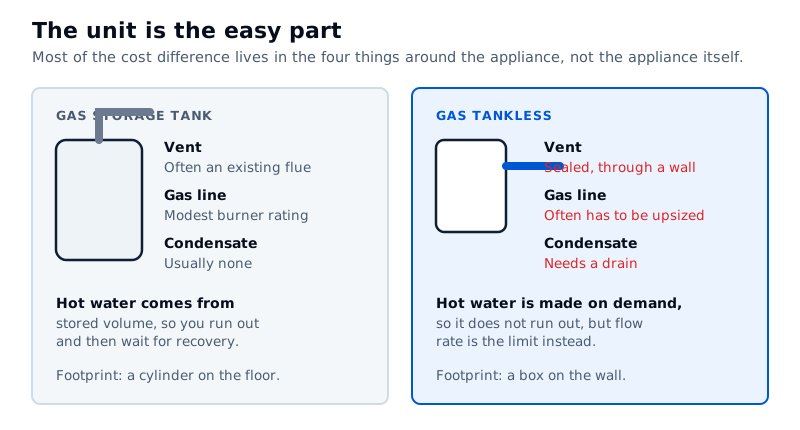
A storage tank keeps a volume of water hot and draws from it. A tankless unit makes hot water on demand, which means it has to do in seconds what a tank does over an hour. That requires a far larger burner, and that single fact drives everything below.
1. Gas Line Capacity
A tankless heater’s burner input is typically several times that of the storage tank it replaces. The existing gas line was sized for the old load.
If the line cannot deliver enough gas, the unit underperforms, and underfired gas appliances burn poorly. Upsizing the line from the meter is frequently the largest single line item in a tankless conversion, and it depends on the run length, the route, and what else is on the same line.
This is also a permitted, licensed activity — not something to discover after the appliance is bought.
2. Venting
A storage tank in an older Lower Mainland home often vents into an existing flue. A condensing tankless unit cannot use that. It needs sealed venting in an approved material — typically stainless steel or polypropylene — routed through a wall or roof with specific clearances from windows, doors, and air intakes.
Where the old tank sits in the middle of a basement with a chimney above it, and the nearest exterior wall is twelve metres away through finished space, the venting alone can change the economics of the whole project.
3. Condensate
High-efficiency condensing units produce acidic condensate that needs a drain, and often neutralisation before it enters the drainage system. If the installation location has no drain nearby, that is a condensate pump and a drain line to route.
4. Flow Rate, Not Volume
This is the one that produces disappointed customers.
A tank runs out and then recovers. A tankless unit never runs out — but it has a maximum flow rate it can heat to a given temperature rise, and in BC our incoming water is cold, which means the rise required is large.
The practical consequence: a unit sized for one shower will struggle if someone runs the dishwasher at the same time. “Endless hot water” is true for duration and misleading for simultaneity.
Sizing must be done against the number of fixtures you actually expect to run at once, at the incoming water temperature we actually have here in winter — not against a marketing figure calculated on a warmer climate.
When Tankless Genuinely Makes Sense
- Space is worth money. Removing a cylinder from a small mechanical room, a suite, or a townhome utility closet is a real gain.
- Hot water demand is spread out rather than simultaneous. A household that showers in sequence suits it well.
- You are already opening things up. A renovation, a suite conversion, or a project that already involves gas and venting work absorbs much of the marginal cost.
- The existing tank location is near an exterior wall with a straightforward venting route.
- You intend to stay. The payback period on the extra installation cost is measured in years, not months.
When a Tank Is the Better Answer
- The existing venting and gas line suit a tank and not a tankless, and changing both is disproportionate to the benefit.
- Demand is simultaneous. Several people showering at the same time is exactly the pattern a tank handles better.
- Budget is the constraint. A straight tank replacement is usually the lower-cost path, and there is nothing wrong with the technology.
- It is an emergency replacement. When a tank fails on a Friday, a like-for-like replacement restores hot water today. A conversion done properly is a planned project.
Do not convert under emergency pressure. If the tank has already failed, a rushed tankless install is how venting shortcuts and undersized gas lines happen. Replace the tank, then plan the conversion properly for a renovation — or decide now, before the tank fails, while you still have a choice.
The Third Option: A Heat Pump Water Heater
Worth naming, because it often is not mentioned.
Heat pump water heaters use electricity to move heat rather than generate it, and they can be considerably cheaper to run than resistance electric. They need a reasonable volume of space to draw heat from, they cool and dehumidify that space (useful in a Lower Mainland basement, unhelpful in a closet), and they need adequate electrical capacity.
They also sit inside BC’s electrification incentive landscape in a way gas appliances do not. If you are already considering a heat pump for space heating, it is worth asking about water heating in the same conversation rather than making the two decisions eighteen months apart.
Questions Worth Asking Before You Sign
- What is the connected gas load after this change, and does the existing line carry it?
- Where does the venting run, and what does that route involve in terms of finished surfaces?
- Where does condensate go?
- What flow rate is this unit sized for, at our winter incoming water temperature, and how many fixtures does that cover at once?
- Is a permit being taken out, and under whose licence?
- What does annual maintenance involve? Tankless units need descaling, and in a hard-water situation that is not optional.
A quote that covers the appliance and the labour but is silent on gas line, venting, and condensate is not a complete quote. Those items do not go away; they just arrive later as a change order.
Maintenance People Do Not Expect
Tankless units need periodic descaling — flushing the heat exchanger to remove mineral buildup. Skipping it reduces output and shortens the appliance’s life. Factor the ongoing cost and access into the decision; a unit installed where a service technician cannot reach it will not get serviced.
Tanks are not maintenance-free either. Anode rods are consumable, and flushing sediment extends tank life. Most tanks never receive either, which is part of why they fail when they do.
If Your Tank Is Leaking Right Now
That is a different article. Start with what to do when a water heater is leaking — safety first, decision second.
Mavi Mechanicals installs and services tank, tankless, and heat pump water heaters across the Lower Mainland. Call (604) 614-0121 to talk through which one your house is actually set up for.