
Resource Guide
Why Hot Water Takes So Long to Reach the Far Bathroom
The wait is the pipe emptying, not the heater warming up. What recirculation actually does, what it costs to run, and when it is the wrong fix.
Someone turns on the tap in the far bathroom and stands there for ninety seconds. The usual conclusion is that the water heater is slow, or getting old, or too small.
It is almost never the heater.
What You Are Actually Waiting For
The water heater made hot water hours ago and has been keeping it hot ever since. The problem is everything between the heater and the tap.
When nobody has run hot water for a while, the water sitting in that pipe cools to room temperature. It is still there, and all of it has to come out before the hot water behind it arrives.
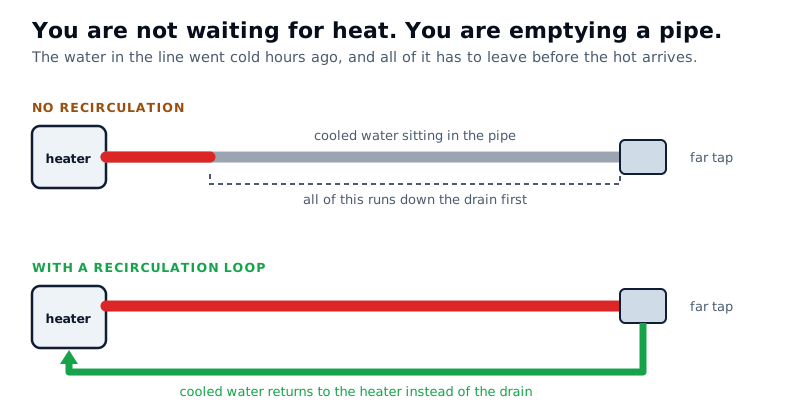
So the wait is set by three things:
- How far the tap is from the heater. The dominant factor.
- The pipe diameter. A larger pipe holds more water per metre, so oversized runs are slower to deliver, not faster.
- How long since hot water was last used on that branch.
None of those improve by replacing the heater. A new tank in the same location with the same piping delivers hot water to that bathroom at exactly the same speed.
What It Is Costing You
Worth being concrete, because it reframes the problem.
Every wait sends cold water down the drain. Repeated several times a day, every day, across a household, that is a genuine volume of treated water going straight to the sewer, and where the water is metered it shows up on the utility bill. It is also the reason people run the tap and walk away, which turns a ninety-second wait into a four-minute one.
The Fixes, Cheapest First
Do nothing structural — just change the habit
If the far bathroom is used at predictable times, running the nearest hot tap briefly first can prime part of the run. Marginal, but free.
Insulate the hot water pipe
Where the run is accessible — a basement ceiling, a crawlspace, a mechanical room — insulating it does not make hot water arrive faster the first time, but it keeps the water in the pipe warm for far longer between uses. For a household that uses that bathroom several times an evening, the second and third uses become near-instant.
This is cheap, non-invasive, and under-used. It is the first thing to do.
A recirculation loop
The proper fix. A dedicated return line runs from the far end of the hot water system back to the heater. A small pump keeps water moving, so the water in the pipe stays hot and is already there when you open the tap.
Where it works well: homes with a long run to a distant bathroom, especially where the return line can be installed during a renovation or where the basement ceiling is open.
The cost people do not anticipate: a dedicated return line has to be physically run. In an open basement that is straightforward. Through finished walls and floors in a three-storey house, it is not.
A comfort system without a return line
Where running a dedicated return is impractical, there are systems that use the cold line as the return path, with a valve under the far fixture. They work, with a real trade-off: the cold line at that fixture is briefly lukewarm after the pump runs. Some households never notice. Others find it genuinely annoying at a bathroom basin.
Worth understanding before you buy, not after.
The Control Strategy Matters More Than the Pump
This is where recirculation systems earn their reputation, good or bad.
Running the pump continuously keeps hot water instantly available everywhere, and it also keeps the entire loop hot twenty-four hours a day. That means standing heat loss all day and all night, and the heater cycling to replace it. It is the setup that produces the complaint “my bills went up after I installed recirculation”, and that complaint is correct.
Running it on a timer matched to when the household actually uses hot water — morning, evening — removes most of that waste while covering the times anyone cares.
Running it on demand, triggered by a button or a motion sensor near the far bathroom, is the most efficient of all. The pump runs for the thirty seconds before you get there, and not otherwise.
A recirculation system set to run continuously is a comfort upgrade with an energy penalty. The same system on demand control is a comfort upgrade with almost none. Ask what control strategy is being quoted, because the difference in running cost is substantial and it is not on the equipment spec sheet.
When Recirculation Is the Wrong Answer
If the complaint is “we run out of hot water”, that is capacity, not delivery. Different problem, different fix, and recirculation will not help.
If hot water is weak rather than slow, that is flow restriction — a partly closed valve, a blocked aerator, or corroded hot lines. Recirculation makes a weak trickle arrive faster; it is still a weak trickle.
If only one fixture is affected and it is close to the heater, something is wrong at that fixture, not in the distribution.
If the house is small and everything is near the heater, a recirculation system is solving a problem you do not have.
On Tankless Units Specifically
Tankless heaters add a wrinkle. They fire on demand, so there is an additional short delay while the unit senses flow and comes up to temperature — on top of the pipe-emptying wait.
Some models are designed to work with recirculation and some are not, and retrofitting the wrong one causes short cycling. If you have a tankless unit, the model matters, and it is worth checking before anything is ordered.
What to Have Ready When You Call
- Roughly how long the wait is, and at which fixtures
- Whether it affects the whole house or one end of it
- Where the water heater is relative to the slow fixture
- Whether the basement ceiling or crawlspace is open or finished
- Whether the heater is a tank or tankless, and its make and model
- Whether a renovation is planned that would open the route anyway
Mavi Mechanicals installs and services hot water systems and recirculation across Surrey, Burnaby, Vancouver and the wider Lower Mainland. Call (604) 614-0121 — and if the answer is “insulate the pipe and change the timer”, we will tell you that rather than sell you a pump.