
Resource Guide
Sump Pump Failure Before the Wet Season: A 15-Minute Test
A homeowner test that finds the three parts of a sump system that actually fail, and what to check before the Lower Mainland rain arrives in earnest.
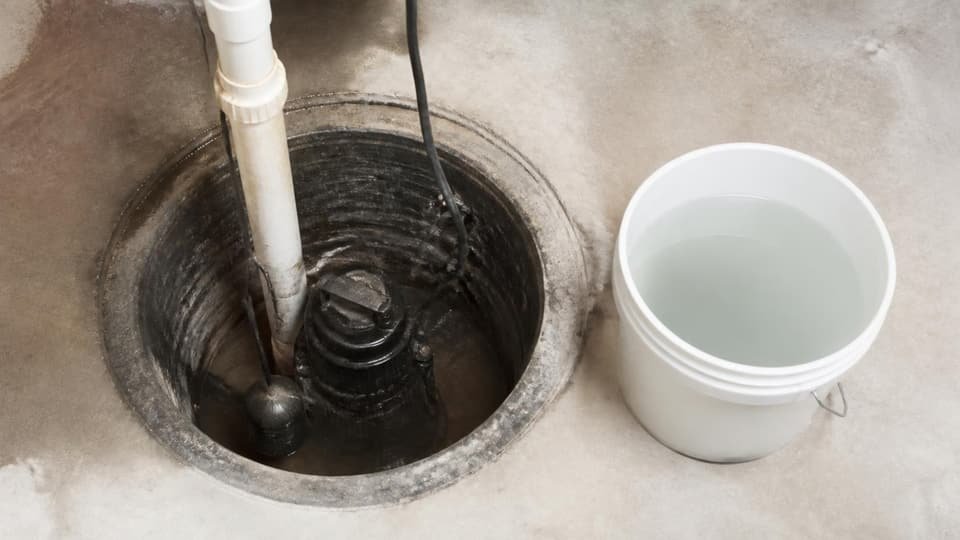
A sump pump is the only piece of equipment in most houses that is tested exclusively by the conditions that make its failure expensive. It sits untouched through the dry months and is then asked to run for days during the first serious atmospheric river of the season.
This is a job for September, not November. It takes about fifteen minutes.
Know What You Are Testing
The pump itself is the part people worry about and the part that fails least often.
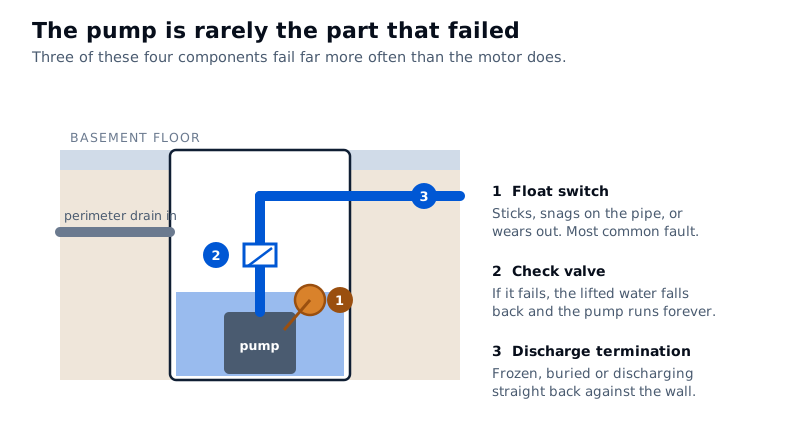
The float switch is the usual culprit. It is a mechanical device in dirty water that has to move freely every cycle. It sticks, it snags on the discharge pipe, it wears out.
The check valve sits in the discharge and stops lifted water falling back into the pit when the pump stops. When it fails, the pump empties the pit, the water comes straight back, and the pump restarts — over and over until it burns out.
The discharge termination is where the water is supposed to leave. Frozen, buried under a season’s leaf fall, disconnected, or simply discharging against the foundation it is meant to protect.
The Test
1. Look Before You Touch
Lift the lid. You should see a pit with water in the bottom, a pump sitting on the base, a float, and a discharge pipe. Check for:
- Gravel, silt, or debris accumulated in the pit — it shortens pump life and jams floats
- A float resting against the pit wall or tangled on the pipe
- Rust, scale, or an obvious buildup on the pump body
- A power cord in good condition, plugged into a working outlet
2. Pour Water In
This is the whole test. Take a bucket and pour water into the pit steadily — not down the pump, into the pit — until the float rises.
Watch for four things:
- Does the pump start? The float should rise and the pump should kick in before the water reaches the top of the pit.
- Does it actually move water? You should hear and feel water moving in the discharge line.
- Does it stop? The float should drop and the pump shut off cleanly. A pump that keeps running with an empty pit is a float problem or a check valve problem.
- Does water come back? Watch the pit for ten seconds after it stops. A significant amount of water flowing back in means the check valve is not holding.
Repeat it twice. Intermittent float faults show up on the second or third cycle rather than the first.
3. Go Outside and Find the Discharge
This is the step people skip, and it is responsible for a good share of the failures we get called to.
Follow the discharge pipe to where it terminates. Then check:
- Is it clear? Leaves, soil, and small animals all block outlets.
- Where does the water go? It needs to run away from the building. A discharge emptying two feet from the foundation is recirculating water through your perimeter drain. It will run forever and protect nothing.
- Is it connected? Buried sections separate. Follow it as far as you can see.
- Will it freeze? A cold snap with an above-ground discharge line can ice a pipe closed. The pump then runs against a blocked line, which it cannot tell you about.
4. Check the Power
Note which circuit the pump is on and whether anything else shares it. If the outlet is a GFCI, press test and reset to confirm it works — a tripped GFCI is a silent failure that only reveals itself when the basement is already wet.
What to Do If It Failed
The pump did not start. Check power first, then the float. If the float moves freely and there is power at the outlet, the pump needs replacing or servicing.
The pump ran but moved nothing. Usually a blocked intake, a jammed impeller, or an airlock. Some pumps have a small weep hole that clears an airlock; if it is plugged, the pump can spin without pumping.
The pump will not stop. Float stuck, or check valve failed. Do not leave it running against this — it will overheat.
Water flows back after it stops. Check valve.
It works but the discharge is blocked. Clear it now, while the weather is dry and the ground is workable.
Whether You Need a Battery Backup
Worth thinking about properly rather than defaulting either way.
The scenario a backup protects against is specific: a power outage during a heavy rain event. In the Lower Mainland, that is not a hypothetical — the same windstorms that bring the rain bring the outages.
A battery backup earns its place when:
- The basement is finished, or stores anything you would mind losing
- Groundwater is high enough that the pump runs regularly rather than occasionally
- The property is on a slope with water arriving from uphill, common around Burnaby Mountain, Capitol Hill, and the North Surrey bluffs
- Nobody is home for long stretches
- The consequence of failure is a strata claim rather than just your own carpet
It is not necessary for a dry, unfinished crawlspace where the pump runs twice a winter.
A useful middle option is a high-water alarm — a cheap device that sounds when the pit level rises above normal. It does not pump anything, but it turns a discovered flood into a caught one.
Beyond the Pump
A sump pump is the last stage of a drainage system, and if it is running constantly the real question is upstream.
- Perimeter drains silt up and collapse. A pump cycling every few minutes in ordinary rain suggests water arriving faster than it should.
- Downspouts discharging next to the foundation feed the perimeter drain directly. Extending them away from the building is one of the cheapest drainage improvements available.
- Grading that slopes toward the house sends surface water down the foundation wall.
If your pump is working hard in moderate rain, ask about the drainage system rather than buying a bigger pump. A bigger pump moves the same water faster; it does not stop it arriving.
On the Calendar
- Early September — the full test above, before the rain
- Mid-winter — lift the lid, pour a bucket, confirm it still cycles
- After any power outage during rain — confirm it restarted
- Every few years — clear accumulated silt from the pit
What to Have Ready When You Call
- What happened during the test, at which of the four steps
- How often the pump runs in normal rain
- Whether the basement is finished
- The approximate age of the pump
- Whether you know where the discharge terminates
- Whether you have ever had water in the basement, and where it came in
Mavi Mechanicals installs, services, and replaces sump systems across the Lower Mainland, including Pitt Meadows, Port Coquitlam, Burnaby and White Rock. Call (604) 614-0121 — and if there is water in the basement now, that is an emergency call, not a scheduled one.