
Resource Guide
Perimeter Drains in Lower Mainland Homes: Signs They Have Failed
What the drain around your foundation does, how it fails, what a camera scope tells you, and why a bigger sump pump is not the answer.
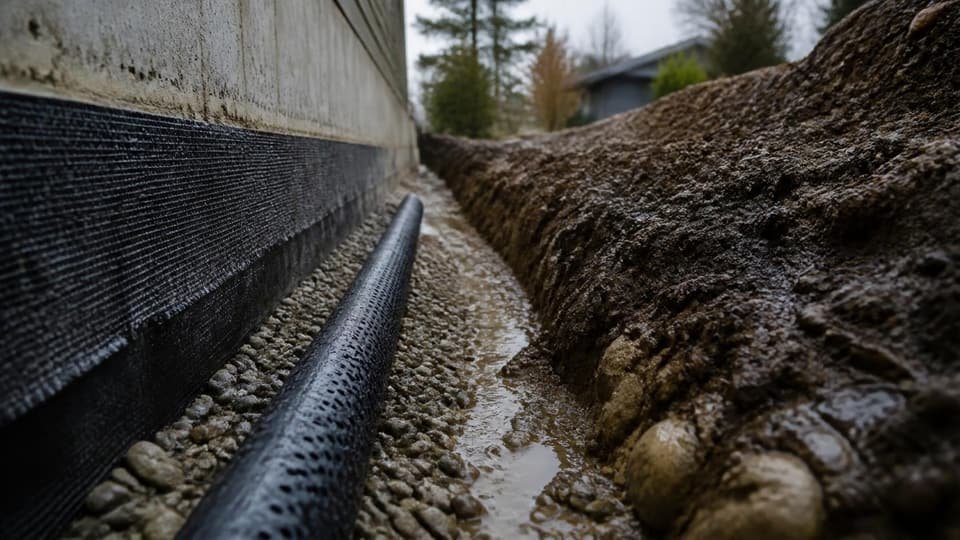
We get roughly two thousand millimetres of rain a year in parts of this region, most of it between October and March. The only thing standing between that and your basement wall is a perforated pipe buried beside the footing that nobody has looked at since the house was built.
What It Actually Does
Rain lands on the roof and the lot, soaks into the ground, and travels downward. When it reaches the foundation wall it follows it down. Without somewhere to go, it builds hydrostatic pressure against the wall and finds a way through — a crack, a cold joint, the wall-floor junction.
The perimeter drain intercepts it first.
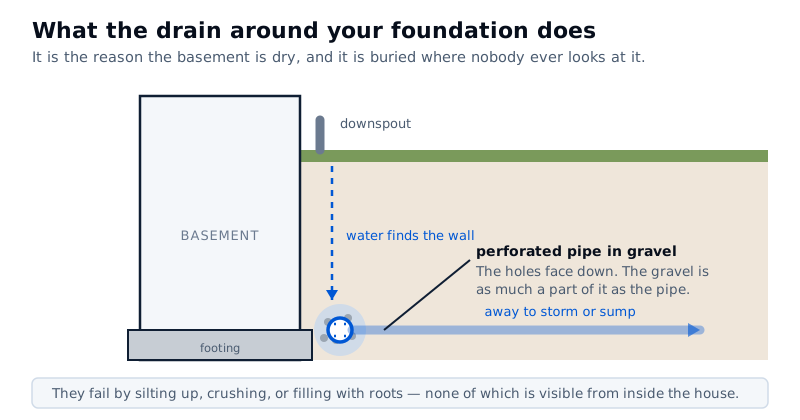
Note what that means: the system is the pipe and the gravel around it and the route it discharges to. All three can fail independently, and two of them are invisible.
Where it discharges depends on the house. Many Lower Mainland homes drain by gravity to the municipal storm sewer at the street, with no pump involved. Others, usually where the basement sits below the storm connection, collect the water in a sump and pump it out. Most systems also have cleanout risers, short capped pipes at the corners of the house, which are how the drain is inspected and flushed without digging.
How They Fail
Silt. The most common by a distance. Fines wash into the gravel and the pipe over decades and gradually fill it. Nothing dramatic happens; capacity just declines until a heavy week overwhelms what is left.
Roots. Same story as a sewer lateral. A perforated pipe full of water beside a tree is exactly what roots are looking for, and the perforations are an open invitation.
Crushing and collapse. Older systems were often laid in thin-wall or clay pipe. Ground movement, vehicle loading over a driveway, or a landscaping project with a small excavator will finish them.
Disconnection at the discharge. The pipe is intact all the way to a point where it stops going anywhere. Common after landscaping, driveway work, or a municipal change at the street.
Never adequate to begin with. Some older Lower Mainland houses were built with no perimeter drain at all, or with a system that was marginal when new.
The Signs, Earliest First
You will not see the drain fail. You will see the consequences.
- The sump pump runs far more than it used to, in the same weather. This is the earliest reliable signal and the one most often ignored. If the house drains by gravity and has no sump, the equivalent is water standing in a cleanout riser after the rain has stopped. Our sump pump test guide covers what normal looks like.
- A damp band along the bottom of the basement wall after sustained rain.
- Efflorescence — white powdery mineral deposit on the concrete, left behind by water passing through it.
- A musty smell that appears in autumn and goes in summer.
- Water at the wall-floor junction, rather than from a pipe.
- Standing water beside the foundation outside, or a downspout outlet that backs up.
- Settlement or cracking in a walkway or patio next to the house.
A pump running constantly is a symptom, not a solution in need of upgrading. The most common wrong move is buying a bigger sump pump. A bigger pump moves the same water faster; it does nothing about why that much water is arriving. Sometimes the pump genuinely is undersized, but that should be a conclusion, not the opening assumption.
Cheap Things to Rule Out First
Before anyone quotes an excavation, eliminate the surface water problems. They are common, they produce identical symptoms, and they cost very little to fix.
Downspouts discharging at the foundation. A roof sheds an enormous volume of water. Dumping it a foot from the wall feeds the perimeter drain directly, at a rate it was never sized for. Extending downspouts away from the building, or connecting them properly to the storm system, is the single cheapest drainage improvement available.
Grading that slopes toward the house. Ground settles over decades, and garden beds get built up. If surface water runs toward the wall, fix that before you dig anything.
Blocked gutters. Water sheeting over the edge of a gutter lands exactly where you do not want it.
A blocked or buried sump discharge. Follow it and confirm it terminates somewhere sensible, well away from the building.
Work through those first. A meaningful share of “failed perimeter drain” calls turn out to be a downspout.
What a Scope Tells You
If surface water is ruled out, the next step is inspection rather than excavation.
A camera run through the perimeter drain from an accessible point shows what is actually in there: silt level, root intrusion, crushed or collapsed sections, and where the discharge goes. It also shows which sections are fine, which matters — a partial repair on the failed run is far cheaper than a full replacement.
A quote for replacing a perimeter drain that was produced without a camera is a guess. Ask to see the footage.
The footage also decides whether you need to dig at all. A run that is silted but structurally sound can often be flushed clear with a water jet through the cleanouts, and roots can be cut out the same way. Excavation is for pipe that is crushed, collapsed, disconnected, or missing. If your system has no cleanouts, adding them during any repair makes every future inspection cheap.
What Replacement Involves
It is real work and worth understanding before you get numbers.
The ground beside the foundation is excavated down to the footing, the old pipe and saturated gravel removed, the wall inspected and usually damp-proofed while it is exposed, new drain rock and perforated pipe laid to fall, filter fabric installed, and the trench backfilled.
The variables that drive cost:
- Depth. A full basement means a deeper trench than a crawlspace.
- Access. A machine that can reach all four sides is a completely different job from one where two sides are hand-dug between a fence and the house.
- What is on top. Lawn is cheap to restore. A driveway, a patio, a mature garden, or a deck are not.
- How much of the perimeter is actually failed. This is what the camera answers.
- Whether the discharge route also needs work.
Because the wall is exposed anyway, this is the one and only sensible moment to damp-proof it, and to deal with anything else in that trench. Doing it again later costs the whole excavation a second time.
Timing
Do the investigation in late summer or early autumn, before sustained rain. Dry ground is easier and cheaper to work in, contractors are less stretched, and you are not making the decision while water is coming in.
The worst time to start is January, which is when most people call.
If water is already coming in this season, do the cheap checks above now, keep the sump and its discharge clear, and book the camera inspection. Flushing and spot repairs can usually be done in wet weather. A full excavation can wait for drier ground if the interim measures are keeping the basement dry.
What to Have Ready When You Call
- The age of the house, and whether the drains have ever been replaced
- How often the sump runs, and whether that has changed
- Where moisture appears inside, and when
- Whether downspouts are extended away from the building
- What is on the ground around the house — lawn, driveway, patio, deck
- Whether any landscaping or excavation has been done recently
Mavi Mechanicals investigates and repairs drainage across the Lower Mainland, including Burnaby, New Westminster, Port Moody and Pitt Meadows. Call (604) 614-0121 — and if the answer is “extend your downspouts and call us in the spring”, that is what we will say.