
Resource Guide
Clogged Drain or Main Line? How to Tell
One clogged sink or a blocked main sewer line? A five-minute test tells you which, what to stop doing right away, and when to call a plumber.
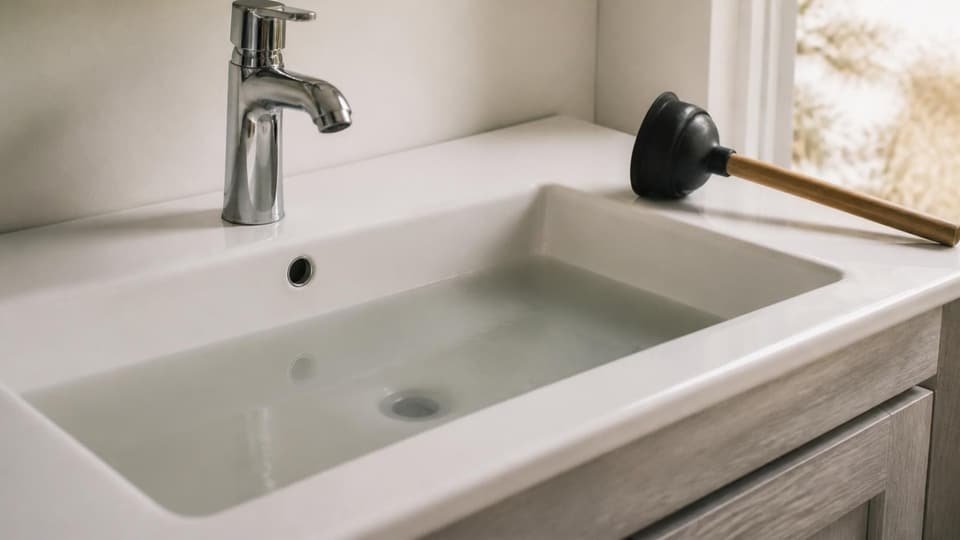
If one sink, tub or toilet is slow and everything else drains normally, the clog is in that fixture’s trap or branch line, and it is usually a small, local job. If running water upstairs makes water gurgle or rise in a basement floor drain, shower or toilet, the main drain is blocked, and that one can put sewage on your basement floor. The test below tells them apart in five minutes and costs nothing.
The Five-Minute Test: One Fixture or the Main Line?
Go to the lowest drain in the house — a basement floor drain, a basement shower, or the lowest-floor toilet. Then have someone run water hard at a fixture on a higher floor: flush a toilet, or run a bath.
Watch the low drain.
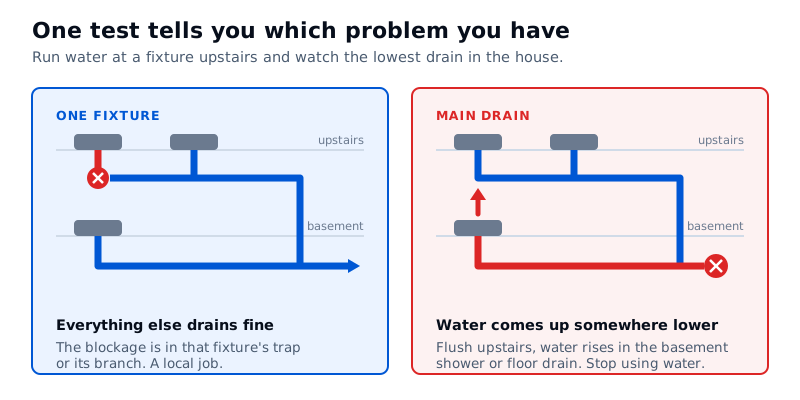
Nothing happens at the low drain. Everything else drains normally, and only one fixture is slow. The blockage is in that fixture’s trap or its branch line. Local problem, local fix.
Water rises, gurgles, or backs up at the low drain. The blockage is in the main drain, downstream of everything. This is the serious one.
Nothing happens downstairs, but several fixtures on one floor are slow. The blockage is probably in a branch or stack those fixtures share. It will not flood the basement, but it is usually beyond a plunger.
If It Is the Main
Stop using water immediately. Every fixture in the house empties into the same blocked pipe. A dishwasher cycle, a load of laundry, or a long shower while the main is blocked does not go away — it comes up through the lowest opening, which is usually a basement floor drain next to things you care about.
Tell everyone in the house. This is the single most useful thing you can do before help arrives.
Then:
- Check whether neighbours have the same problem. If two or three properties on the street are backing up at once, the blockage is likely in the city main, so call your municipality before a plumber. In Surrey the sewer backup number is 604-591-4152, and if City crews can reach your inspection chamber, a blockage on the City side is cleared at no cost to the owner.
- Find your cleanout — the capped access point, often in the basement floor or just outside the foundation. Many homes also have an inspection chamber near the property line; in Surrey it usually sits just on the City side, and crews need it uncovered. Knowing where both are saves time on the call.
- Do not open the cleanout yourself if the line is full. It is holding back everything upstream of it, and it will not come out politely.
- Photograph any water damage before you clean up, in case there is an insurance claim.
- Keep people and pets out of any water that has come up. It is sewage. If it has reached outlets, a furnace or a water heater, stay out of it entirely.
If the neighbours are fine, the blockage is in your own line, and clearing it takes a drain machine and ideally a camera to see why it blocked. That is our drain cleaning and sewer service. If water is already on the floor, it is an emergency call: (604) 614-0121, our 24/7 line.
If It Is One Fixture
Much less urgent, and a few things are worth trying.
Kitchen sink. Almost always grease combined with food solids, accumulating on the pipe wall over months. Very hot tap water can help with early buildup. Boiling water adds a scald risk when it splashes back out of a full sink, and neither does anything once the pipe has genuinely narrowed. A cup plunger used properly — on a double sink, with the other drain blocked off — moves more blockages than people expect. If the sink has a garbage disposal, a jammed unit can look like a blocked drain; turn it off at the switch and the breaker before checking it, and never reach inside.
Bathroom sink. Usually hair and soap on the pop-up stopper assembly, within reach. Remove the stopper and clean it before assuming the pipe is the problem. If you plunge it, hold a wet cloth over the overflow hole first.
Shower or tub. Hair in the trap. Same idea, harder to reach.
Toilet. A flange plunger, not a cup plunger. If it will not clear, stop before you flush again to “test” it.
Two things not to do.
Chemical drain cleaner. It frequently fails to clear the blockage and then sits in the pipe as a caustic column. The next person to open that trap — possibly you, possibly a plumber who was not told — gets it on their hands and face. Do not plunge a drain with cleaner standing in it, because plunging splashes it back out. If you have used one, say so when you call. It genuinely changes how the work is done.
A rented auger into an old pipe. Cast iron and clay that have corroded or cracked can be turned from a blockage into a replacement by an auger driven hard by someone who cannot see what it is hitting.
Slow and Gurgling: Blockage or Vent?
If a fixture drains slowly and something else gurgles when it does, the drainage system is pulling air through a trap. Two things cause that: a partial blockage in a pipe the two fixtures share, or a vent that is not supplying the air the drain needs. From the sink they look the same.
If the test above shows the main is clear and plunging the slow fixture changes nothing, a blocked vent moves up the list, especially alongside a sewer smell that comes and goes. Our guide to sewer smell in the basement explains how traps and vents work together.
When the Main Line Keeps Clogging
A main line that blocks once can be bad luck. A main line that blocks repeatedly in the same place is telling you something.
Roots, a settled section holding water, an offset joint, or a crack all produce a line that clears and then re-blocks on a predictable schedule. Older Lower Mainland homes with clay or concrete sewer laterals and mature trees nearby see the root version most often. If snaking buys you three months, twice, the third call should be a camera inspection rather than a third snaking. What each failure looks like, and where your responsibility ends and the city’s begins, is in our guide to who pays for a broken sewer line in BC.
What to Have Ready When You Call
- Which fixtures are affected and which are fine
- What happened during the test above
- Whether anything gurgles
- Whether you have poured any chemical cleaner down it
- Whether this has happened before, and how long ago
- The age of the house and whether you know where the cleanout is
Mavi Mechanicals handles drain blockages, camera inspection, and main line repair across the Lower Mainland, including Surrey, Vancouver, Burnaby and New Westminster. For an active backup, call (604) 614-0121 — that is an emergency call, not a scheduled one.
Check these yourself
- City of Surrey — sanitary sewer issues and backups
- City of Surrey — sanitary sewer maintenance for property owners
- Outside Surrey, your own municipality’s sewer bylaw and backup line